World Dossier
Page 1 of —
1. Geography & Scale
The Five Rings occupies a single continuous landmass organized as five concentric mega-rings. The civilization houses approximately 4.3 billion residents.
Main Layer is the largest ring by physical area, proportional to its population. Sanctuary occupies the innermost band — smaller, denser, and architecturally distinct. The lower layers occupy progressively narrower outer bands, with -3 Terminal at the civilization's outer perimeter.
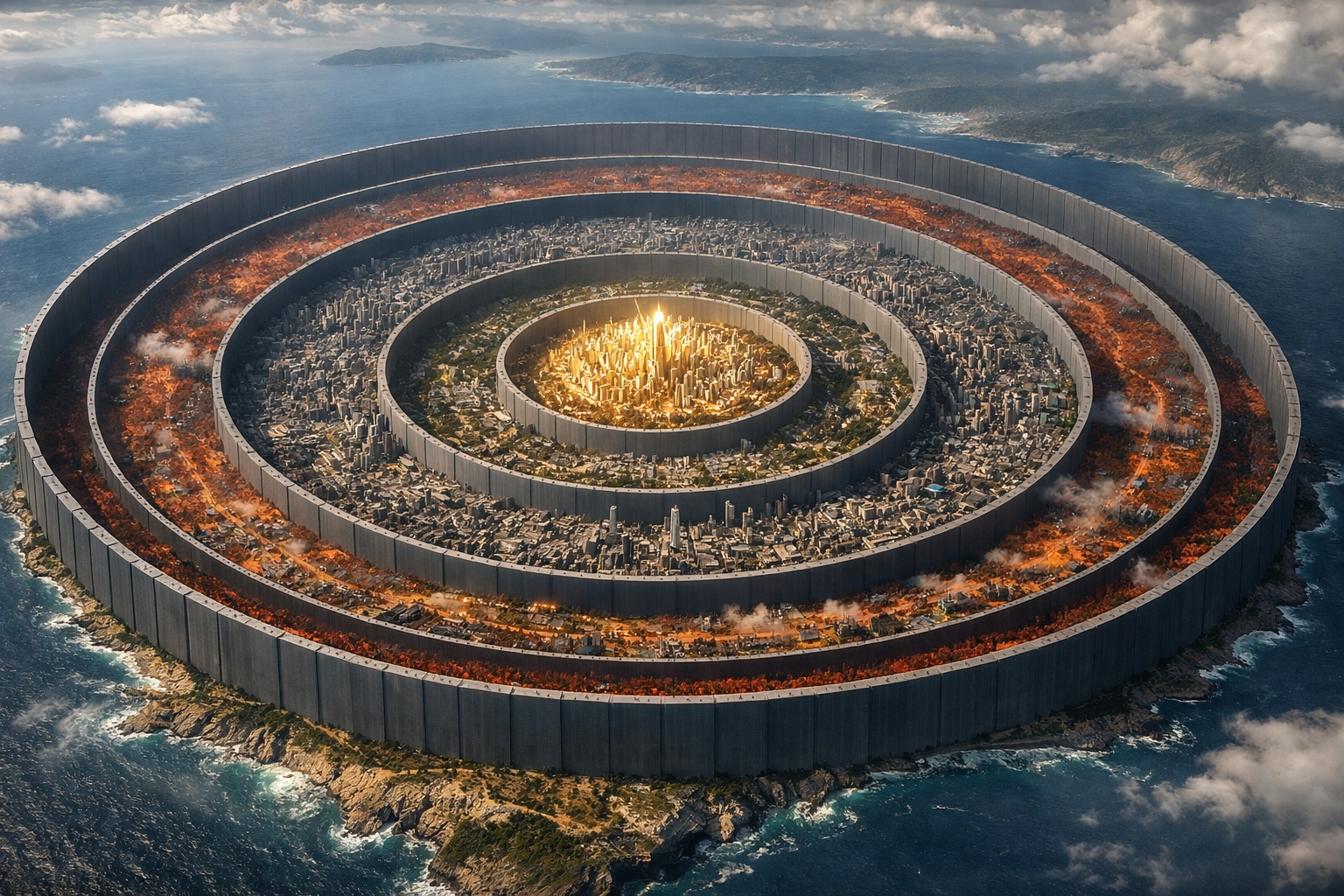
Every ring boundary is separated by a mega-wall — 15km above ground, 5km below ground, with a 1km base cross-section tapering parabolically above midpoint to a ~1m crest at peak altitude, constructed from advanced composite materials produced in fabrication proxy installations. The outer perimeter carries the same wall. These are structural boundaries, not aesthetic ones — colossal blades jetting out of the earth, sheer-faced and nearly insurmountable between zones. They prevent breach in every direction.
Each dimension is calibrated to a specific threat boundary. The 15km height sits at the exact altitude where civilian aviation capability ends and military capability begins — commercial airliners cruise at 10–13km, private jets ceiling at 15.5km, and only dedicated military aircraft clear the wall. Any overflight is an unambiguous act of war. The 5km sub-surface depth exceeds the deepest operational mine ever constructed (4km) and sits well beyond the thermal gradient where sustained tunnel operations become physically impractical (~150°C). The 1km base thickness exceeds the penetration depth of every conventional munition in existence by orders of magnitude, and advanced composite materials outperform reinforced concrete significantly across the entire profile. Embedded seismic sensors and ground-penetrating radar detect approach from any vector. The wall does not need to survive sustained superpower bombardment. It eliminates every breach scenario below full-scale war — and the military deterrent eliminates war itself.
Sanctuary, despite its smaller footprint, functions as the civilization's demographic and cultural core. Over long time horizons, residents flow outward — settling in Main, pairing across layers, carrying high-trust norms and cultural continuity into the broader population. The inner ring is not a closed elite — it is a source population that continuously replenishes the civilization it sits at the center of.
The ring layout is visible from orbital altitude. VMSS makes no effort to conceal its geography.
Border Interface
There are no border communities in the conventional sense. The mega-wall eliminates gradual transition zones — a 15km barrier with 5km sub-surface depth does not permit the interwoven daily life that develops along porous borders. Populations on the foreign side of the wall interact with VMSS exclusively through official border crossings, embassies, and diplomatic channels. A village one kilometer from the VMSS perimeter has no more physical access to the civilization than a city on the other side of the continent. The wall converts proximity into irrelevance.
This is architecturally deliberate. Porous borders create gray zones — smuggling corridors, dual-jurisdiction populations, communities with divided loyalties. The mega-wall eliminates all three. Every interaction between VMSS and the outside world is channeled through controlled infrastructure where implant verification, ledger audit, and behavioral evaluation operate. There is no back door, no informal crossing, no border town where two legal systems blur into each other.
Cross-Border Spillover
The lower layers do not export crime. -3 Terminal sits at the outer perimeter, but the outer perimeter is a mega-wall — the same 15km above ground, 5km below, 1km-base-tapered structure that separates every ring. Physical exit from -3 requires breaching a military-grade barrier. Inward spillover — contraband or people moving through -2, -1, Main, Sanctuary, and out — requires passing through multiple mega-wall checkpoints, each with full implant surveillance and behavioral monitoring. The architecture makes cross-border criminal export physically impossible at any scale below military invasion.
Foreign accusations that VMSS "exports crime" through its lower layers are addressed the same way all disinformation is addressed: published architecture, verifiable structure, open inspection for allied nations. The layers are not hidden. The walls are visible from orbit. Any nation claiming that -2 or -3 generates cross-border harm is invited to explain the mechanism by which that harm traverses five concentric mega-walls and a persistent drone surveillance network.
2. History
The Five Rings was founded through a sovereign treaty establishing territorial boundaries and the constitutional framework for gradient governance. The founding was not unopposed.
Era I
Founding
Sovereign treaty signed. Territory claimed. External powers sceptical or hostile.
Era II
Contested Period
Wars fought against a civilization whose doctrine was radical but whose military capability had not yet matured.
Era III
Consolidation
Walls reached full height. Technology matured. Military challenges became increasingly one-sided.
Era IV
Superpower
Deterrent self-sustaining. Diplomacy replaces conflict. Strategic equilibrium established.
In its earliest years, VMSS lacked the technological maturity that defines it today. The mega-walls were unfinished. Implant infrastructure was nascent. The nanobot plumes that now constitute the civilization's primary external deterrent did not yet exist.
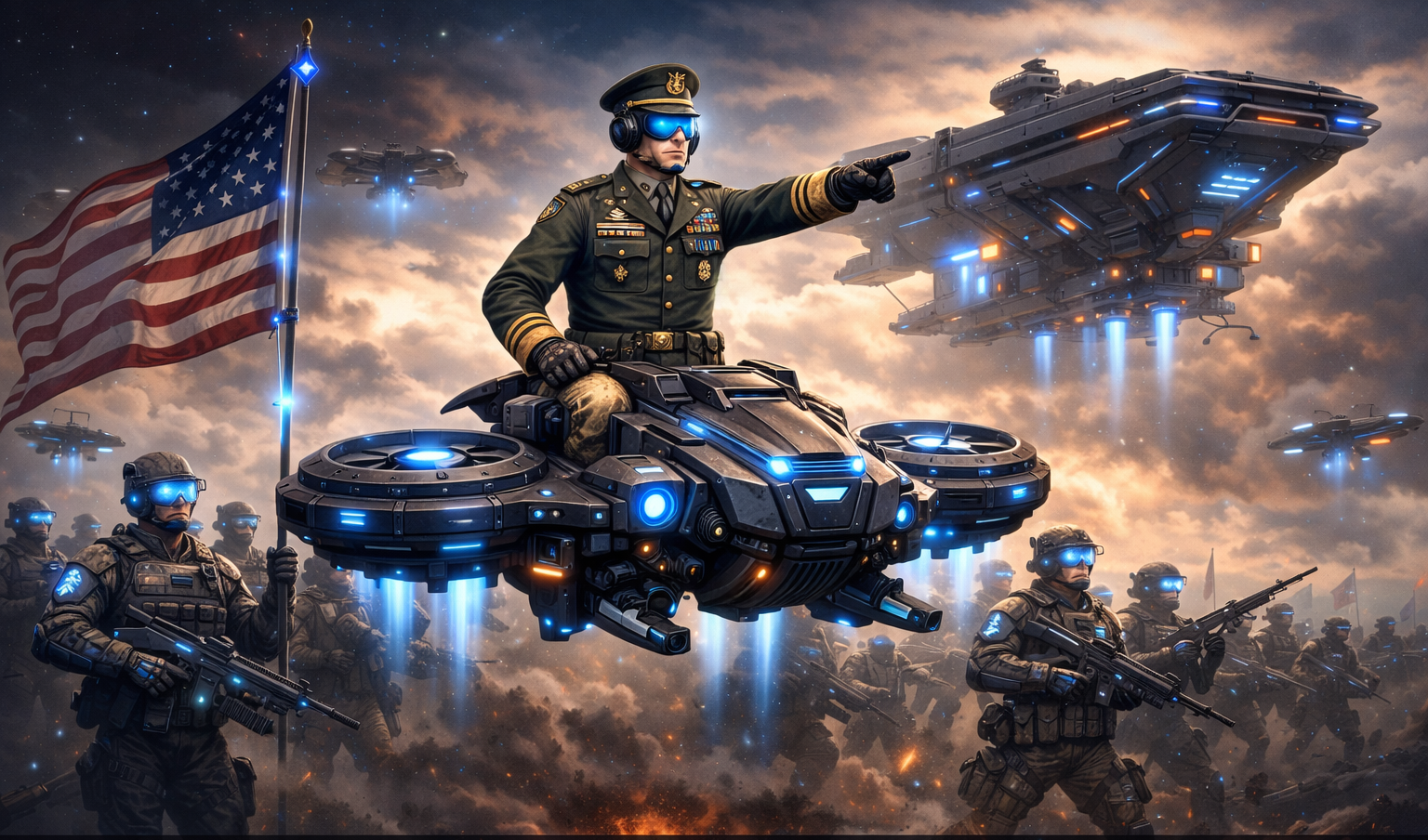
A founding ally — the first external civilization to adopt a ring-gradient model — provided critical support during this era. That relationship carries historical weight and remains the closest bilateral partnership in the current alliance structure.
The consolidation period followed. Walls reached full height. Implant technology matured to civilization-wide deployment. Military capability advanced past the point where conventional challenge was viable. The final serious external military confrontation ended decisively, and the deterrent became self-sustaining.
No state actor has contested VMSS militarily since the consolidation era. Rival superpowers possess the capability to threaten the civilization, but the cost of engagement is mutually catastrophic. The result is strategic equilibrium, a balance where diplomacy is cheaper than war for all parties.
The Geopolitical Landscape at Founding
The Founding Treaty was signed on March 29, 2026, into a world that was not waiting for it. The United States and China were locked in a technology and trade competition that defined the global order. Russia was engaged in active territorial conflict in Eastern Europe. India was ascending as the world's most populous democracy. The European Union was fracturing along nationalist lines. The Middle East remained unstable. Africa's population was surging past 1.4 billion with some of the youngest demographics on the planet.
Each power bloc responded to VMSS differently. The United States viewed it as a sovereignty challenge — a new civilizational actor claiming territory and citizens outside the existing international order. China saw a competitor for technological supremacy, particularly in AI and biological augmentation. Russia treated it as an ideological threat to state authority. India's response was divided: enormous public interest from a population familiar with hierarchical social structures, matched by governmental suspicion of a system that bypassed democratic elections. European nations were individually ambivalent — culturally sympathetic to the human rights framing, institutionally hostile to the governance model. African and Southeast Asian nations provided the largest raw applicant pools per capita, driven by populations with the least to lose and the most to gain from voluntary relocation to a post-scarcity civilization.
The founding did not happen in a vacuum. It happened into active geopolitical competition, and every major power's response was shaped by what it stood to lose — not what the new civilization offered. This is the pattern that defines VMSS's diplomatic history: the civilization is evaluated by threat, not by merit, until the merit becomes impossible to deny.
A Migration Without a Catastrophe
Every prior mass migration in human history had a catastrophe behind it. The Great Migration out of Africa was driven by climate. The Transatlantic slave trade was driven by force. European colonization of the Americas was driven by famine, persecution, and economic desperation. The 20th century's refugee waves — from the Holocaust, the Partition of India, the Syrian civil war — were driven by violence. The pattern is universal: people move at scale only when staying is worse than the uncertainty of going.
VMSS breaks this pattern. The migration into The Five Rings is the first mass movement in human history driven entirely by aspiration rather than desperation. Nobody joining VMSS is fleeing a war zone or a famine — they are choosing a superior civilizational offer over a functional but inferior one. This changes the demographic composition of the founding population fundamentally. Refugee migrations select for survivors. Aspiration migrations select for people who evaluate systems, weigh trade-offs, and make deliberate choices about their own futures. The self-selection filter is not an accident — it is the mechanism that makes the civilization's founding population qualitatively different from any prior mass migration in human history.
The Alternative Narrative: Demand From the Top
The default assumption is that a new civilization attracts the desperate — refugees, the impoverished, people with nothing to lose. The UBI signal alone supports this: $120,000/year is life-changing for someone earning $95/month. But this framing misses a second demand curve that emerges simultaneously and, over time, dominates the first.
VMSS does not just offer economic security. It offers neural diving concerts where you feel the music from inside the performer's body. ImmersionTube — a full sensory media platform that makes every Earth streaming service look like radio. Extreme sports where death is real and permanent consequences are zero. Dream libraries. Collaborative consciousness. Sensory art forms that have no Earth analog. Gaming infrastructure backed by civilizational-scale audiences, institutional legitimacy, and 20-hour work weeks. The Gamers Domain. The Metalheads Domain. Selective Ascension Domains that let you live among people who share your exact values, filtered by metric, not by geography or income. Entertainment and lifestyle packages that no amount of money can buy on Earth — because the underlying technology does not exist there.
This changes who is standing at the door. A tech executive in San Francisco is not fleeing poverty. A hedge fund manager in London is not escaping a war zone. A K-pop idol in Seoul is not desperate. But they are all looking at a civilizational entertainment offering that makes their current reality feel like a black-and-white television — and they want in. The demand curve from the top is not charity-seeking. It is status-seeking. And status-seeking populations do not wait patiently in line. They bid.
Both narratives are true simultaneously. The garment worker in Dhaka joins for the UBI floor. The venture capitalist in Manhattan joins for the lifestyle ceiling. The founding population is not one demographic or the other — it is both, arriving through the same door for completely different reasons, sorted into the same behavioral architecture regardless of what brought them there. The civilization that was expected to attract the world's most desperate instead attracts its most ambitious, and the entry process begins to resemble a high-end music festival more than a refugee camp — with priority access, bidding wars, and waitlists that make exclusion feel like a personal failure rather than an institutional rejection.
"Why Didn't You Go?"
By 2126 — one century after the Founding Treaty — the children of Earth holdouts ask a question that has no comfortable answer: "Why didn't you go?" The parent who chose to remain on Earth in 2026 made that choice against a specific backdrop: scepticism about a new civilization, attachment to existing institutions, distrust of the offer. One hundred years later, the results are visible. VMSS citizens live 200–300 years. Their children were born into post-scarcity with independent legal advocates and guaranteed income from birth. Their medical drones arrive in seconds. Their convicted populations live materially better than most Earth nations' free citizens.
The holdout parent is now 80 years old — if they are still alive. Their VMSS counterpart is 130 and biologically 35. The parent's grandchildren inherit an 80-year lifespan ceiling, an economy that still permits homelessness, and a justice system with a 65% recidivism rate. The VMSS counterpart's grandchildren inherit centuries of life, compounded family knowledge in living relatives, and an environment where the worst neighbourhood is materially superior to the Earth median. The generational ledger of preventable loss — shortened lives, foregone income, unprotected children, untreated illness — compounds silently across every decade of delay. No one who stayed will be prosecuted for the choice. But their descendants will carry the cost, and they will know it.
3. Military Posture
The Five Rings maintains separate capability stacks for internal enforcement and external defense.
Internal
Implant Kill Switch — instantaneous neutralization at any scale. Hardware-level, requires no deployment. Operates only on residents who consented to implant installation. No external application.
External — Biological
Nanobot Neutralization Plumes — capable of biological neutralization across any area of operation. Does not require implants. Publicly acknowledged, specifics classified.
External — Kinetic
Kinetic Weapons Systems — destruction of armored units, military installations, and infrastructure. Conventional capability at unconventional scale.

VMSS's military posture is defensive. The civilization has never expanded its territorial boundaries beyond the founding charter. Its capability exists to ensure that no external actor can threaten the architecture that 4.3 billion residents depend on.
Deterrence posture: The civilization's external military capability is publicly acknowledged. Operational specifics are classified. The acknowledgment itself is the deterrent — potential adversaries know what exists without knowing precisely how it would be deployed.
Orbital Sovereignty
Orbital fabrication stations are the civilization's most critical infrastructure — they produce backup vessels, medical systems, advanced materials, and the physical substrate of continuity itself. These assets operate in sovereign orbital territory. VMSS claims exclusive jurisdiction over the orbital corridors its satellites occupy and maintains a defense perimeter around each installation. Foreign spacecraft, whether civilian or military, are prohibited from approaching within the published exclusion zone without advance treaty authorization. Unauthorized approach is treated as a sovereignty violation equivalent to unauthorized airspace entry — the response escalates from warning to interdiction to destruction depending on trajectory and assessed intent.
Allied nations with their own orbital assets coordinate through published corridor agreements — deconfliction is mechanical and treaty-governed. VMSS does not claim sovereignty over all orbital space. It claims sovereignty over the corridors its infrastructure occupies and defends them with the same posture it applies to terrestrial borders.
Wartime Conduct & Captured Combatants
VMSS does not wage wars of conquest, occupation, or regime change. Military engagement is threat neutralization — overwhelming, temporary, and bounded by doctrine. When the threat is neutralized, military operations cease and the border restores.
Enemy combatants captured during military operations are processed through behavioral evaluation — the same system applied to immigrants and refugees. A conscript soldier with no independent criminal history enters Main Layer if they choose to remain in VMSS. A commanding officer responsible for ordering atrocities is placed in the layer their conduct warrants. Captured combatants who do not wish to remain are repatriated when hostilities conclude — VMSS does not hold prisoners of war indefinitely. Detention during active hostilities is temporary, humane by charter standard, and terminates when the conflict ends. The civilization fights to neutralize threats, not to accumulate captive populations.
Technologies Deployed in War
VMSS's domestic technologies — designed for medicine, continuity, augmentation, and enforcement — become decisive military instruments when the civilization is forced to fight. The same infrastructure that sustains 4.3 billion civilians in peacetime produces capabilities that no conventional military can match.
Biological Augmentation
VMSS soldiers are not baseline humans. Nanosuit-skin hardens on impact — a second dermal layer that absorbs ballistic force, seals wounds in real time, and regulates temperature across extreme environments. Gill augmentation enables indefinite underwater operation without equipment — amphibious units surface inside harbor defenses, behind seawalls, through drainage infrastructure. Wing-membrane augmentation permits short-range powered flight from elevation — soldiers drop from aircraft without parachutes and maneuver laterally to landing zones that conventional paratroopers cannot reach. Every augmentation is reversible, service-grade, and maintained by the same medical infrastructure that services the civilian population.
Scenario: A coastal defense battery shells incoming naval vessels. Thirty augmented operators surface inside the harbor through underwater approach — no boats, no landing craft, no radar signature. Nanosuit-skin absorbs small arms fire during the sprint from waterline to battery. The position is neutralized before the defenders identify the attack vector. The fleet never needed to close within artillery range.
Transanimal Espionage
Neural diving — the same technology used for empathy education and art in civilian life — permits operators to pilot animal hosts in audience mode (passive observation) or pilot mode (full motor control with consent-override authorized for military animals). Crows perch on command post rooftops. Rats navigate ventilation systems inside hardened bunkers. Stray dogs wander through checkpoints. Each carries a micro-relay implant that streams sensory data to the operator in real time. The intelligence is perfect — no electronic signature, no drone silhouette, no equipment to detect.
Scenario: An enemy general briefs his staff in a secure underground facility swept for electronic surveillance twice daily. A rat in the ventilation duct above the briefing table carries a neural relay. The VMSS operator sees the map, hears the plan, reads the unit designations. The counterstrike is pre-positioned before the briefing ends. The general never learns how the ambush was anticipated — his facility was clean. The rat was not on his threat model.
Backup Vessel Warfare
VMSS soldiers do not die permanently. A killed operator revives in a backup vessel within VMSS territory — same memories, same skills, same mission context up to the last sync. This inverts the fundamental calculus of attrition warfare. Kill-target strategies — assassinating commanders, sniping specialists, destroying elite units — produce temporary tactical delays, not permanent capability loss. The commander revives, debriefs, and redeploys. The sniper's target returns with knowledge of the firing position. Every kill becomes an intelligence event: the revived soldier knows where they died, how they died, and what the enemy's position looked like in the final moments before death.
Scenario: A deep-cover reconnaissance operator is captured behind enemy lines. Interrogation begins. The operator offers nothing — and doesn't need to resist indefinitely. Within hours, the backup vessel activates. The operator is alive in VMSS territory with complete recall of the capture: the patrol route that found them, the facility they were taken to, the faces of the interrogators, the layout of the building. The enemy extracted no intelligence. VMSS extracted all of it — from the death itself.
Offensive Neural Warfare
The nanobot plumes acknowledged as VMSS's primary external deterrent are not limited to biological neutralization. Nanoscale delivery systems can interface with electronic infrastructure — communications equipment, targeting systems, vehicle control networks — and with biological neural tissue directly. Deployed offensively, nanobot saturation of a battlefield enables remote override of enemy vehicles, corruption of targeting data, and in extreme escalation, direct neural interference with enemy combatants: disorientation, motor disruption, or induced unconsciousness. The technology that monitors VMSS citizens' behavioral data domestically can, in wartime, be weaponized to read and disrupt enemy neural activity at range.
Scenario: An armored column advances on a VMSS border position. Nanobot plumes deploy at range — invisible, undetectable by conventional sensors. Vehicle electronics begin failing: navigation locks, turrets traverse on their own, engines stall. Crews dismount into open ground. The second wave reaches biological systems — sudden vertigo, loss of motor coordination, unconsciousness. The column stops. Not a single VMSS round was fired. The crews wake up hours later in a field hospital, unharmed, facing behavioral evaluation as captured combatants. The armor is intact. The offensive is over.
Air Superiority
VMSS air assets are autonomous, hypersonic, and networked. Fabrication satellite technology produces airframes from materials that no Earth-based manufacturing can replicate — lighter, stronger, and radar-absorbent by material composition rather than geometric shaping. Drone swarms operate in coordinated formations governed by AI combat doctrine, making decisions at machine speed without pilot latency. No VMSS aircraft carries a pilot — command-and-control is handled by neural-linked operators in secure positions within VMSS territory. Removing the human from the airframe eliminates G-force constraints, life support weight, cockpit vulnerability, and crew rotation. Every aircraft is smaller, faster, more maneuverable, and fully expendable. Hypersonic strike platforms deliver kinetic payloads from orbital altitude — the transit time from authorization to impact is measured in minutes, not hours.
Naval Dominance
The entire naval fleet is unmanned. Submarine drones patrol autonomously at depths and durations that crewed vessels cannot match — no life support, no crew rotation, no oxygen constraints. Surface autonomous vessels coordinate with orbital surveillance to maintain persistent maritime awareness across entire ocean basins. No VMSS ship carries a crew; operators command from VMSS territory through neural link, and the vessels themselves execute AI combat doctrine independently when communication is denied. Amphibious capability is augmented by bioaugmented ground operators who need no landing craft. Naval engagements are asymmetric by design: VMSS naval doctrine prioritizes making the enemy's fleet irrelevant rather than destroying it — nanobot deployment can disable an entire carrier group without sinking a single ship.
Orbital & Spacecraft Assets
VMSS maintains distinct orbital asset categories: fabrication stations produce backup vessels and materials continuously, while defense platforms provide kinetic bombardment capability and battlefield surveillance. Kinetic rods dropped from orbital altitude deliver devastating precision strikes without explosive payloads — inert rods at terminal velocity carry the energy of tactical weapons with none of the radioactive fallout. Defense platforms provide real-time surveillance at resolution levels that make concealment impossible. Any military asset visible from orbit is targetable from orbit. The space domain is not contested — VMSS occupies it permanently.
Ground Forces & Vehicles
Ground vehicles are autonomous, unmanned, fabrication-grade armored, and networked into the same AI combat doctrine that governs air and naval assets. No tank, transport, or artillery platform carries a crew — they are neural-linked or fully autonomous. Exosuit infantry are the only human presence on the battlefield, operating with strength amplification, integrated medical response, and nanosuit-skin protection that makes individual soldiers more survivable than armored vehicles in conventional armies. Logistics are simplified by fabrication capability — forward operating bases can manufacture replacement parts, ammunition, and medical supplies on-site from raw materials. The supply chain that conventional armies depend on — and that adversaries target — is compressed to raw material delivery. Destroy a VMSS supply convoy and the forward base fabricates replacements from local resources.
The asymmetry is total.
- You shoot their soldier. They revive with intel about your position.
- You shoot down their aircraft. Nobody was in it. Another one launches.
- You sink their ship. Nobody was on it. The fleet doesn't flinch.
- You destroy their tank. It was unmanned. The replacement fabricates at a forward base.
- You kill their commander. They're back in hours with the same memory and your interrogation facility's floor plan.
- You sweep for surveillance. The crow on the roof was the surveillance.
- You hold a defensive position. The nanobot plume is already inside. Your vehicles stop responding. Your soldiers lose consciousness.
Every doctrine a conventional military trains on — attrition, decapitation, interdiction, siege — produces zero permanent effect. Meanwhile, every soldier on the conventional side who dies is gone forever. Every vehicle destroyed is a permanent loss. Every commander killed fractures the chain of command permanently. The moment a conventional military's officer corps understands what they're facing, the war is strategically over — the only variable is how many of their people die before the political leadership accepts it. This is why no state has contested VMSS militarily since the consolidation era. The capability is not secret. The deterrent is the knowledge of what it produces.
External Force Doctrine — Imminence Thresholds
VMSS's "defensive only" posture is not a pacifist commitment. It is a doctrinal constraint with explicit imminence thresholds for the use of off-territory force against non-allied actors. The civilization does not initiate territorial expansion, regime change, or punitive expedition. It does reserve the right to act preemptively against verified existential threats developing outside its borders, under defined conditions.
Tier 1 — Diplomatic and Economic Response
Hostile rhetoric, conventional military buildup, treaty violations, or sanctions evasion trigger graduated diplomatic and economic response. Sanctions, trade restriction, alliance coordination, treaty isolation. No force is deployed. The actor retains full sovereign autonomy and is given a published off-ramp.
Tier 2 — Defensive Mobilization
Verified intent to deploy weapons capable of bypassing the mega-wall (orbital strike, hypersonic, biological, cyber-physical sabotage of orbital and spacecraft assets or backup vessel infrastructure) triggers defensive mobilization at the relevant border or orbital corridor. Capabilities are publicly demonstrated as deterrent. No first strike. The actor is informed of the threshold they are approaching and is given a final opportunity to stand down.
Tier 3 — Preemptive Neutralization
Verified deployment readiness of bypass-capable weapons against VMSS territory or orbital and spacecraft infrastructure crosses the imminence threshold. At this stage, VMSS reserves the right to neutralize the specific weapon system, launch infrastructure, or command-and-control node responsible — scoped to the imminent threat, not to the broader state. The action is not a war of conquest, not a regime change operation, and not a general military engagement. It is a targeted neutralization of an imminent existential threat to the architecture 4.3 billion residents depend on. The Supreme Court is convened in emergency session to verify the imminence finding before authorization. The President's signature is required. The action is publicly disclosed within seven days of execution, including the evidentiary basis for the imminence finding.
Tier 4 — Civilizational Defense
Active attack on VMSS territory, orbital and spacecraft assets, orbital corridors, or treaty allies triggers full civilizational defense. The technologies described above operate without further authorization. The conflict ends when the threat is neutralized — VMSS does not pursue retaliatory expansion, occupy non-allied territory, or impose post-conflict regime structures. When the threat ends, military operations cease and the border restores. Captured combatants are processed under the Wartime Conduct provisions above.
The framework distinguishes preemption from prevention. Preemption against an imminent, verified, deployment-ready existential threat is doctrinally permitted under Tier 3 with the procedural checks named. Prevention against speculative future capability — bombing a research program, assassinating a scientist, sabotaging early-stage development — is doctrinally forbidden. The civilization does not act on capability alone. It acts on capability plus deployment intent plus imminence, verified through evidence, signed off by the President, and reviewed in emergency session by the Supreme Court. The Tier 3 threshold is deliberately high. The civilization that wants to be the kind of civilization VMSS is cannot afford a doctrine that lets fear of future capability justify present force.
Treaty allies are bound by published reciprocal obligations under the Federation Treaty. An attack on a treaty ally triggers VMSS Tier 4 response under treaty terms. An ally that initiates aggression against a non-allied state outside treaty self-defense scope acts on its own authority and forfeits VMSS military backing for that operation. The alliance is defensive by treaty design.
4. Alliance & Diplomacy
VMSS maintains alliance treaties with a number of civilizations that adopted gradient governance models — some with four rings, others with six, each calibrated to their own populations and founding conditions. These are sovereign civilizations with shared structural principles, not a federation. They cooperate on defense, trade, and citizen mobility while maintaining full autonomy over internal governance.
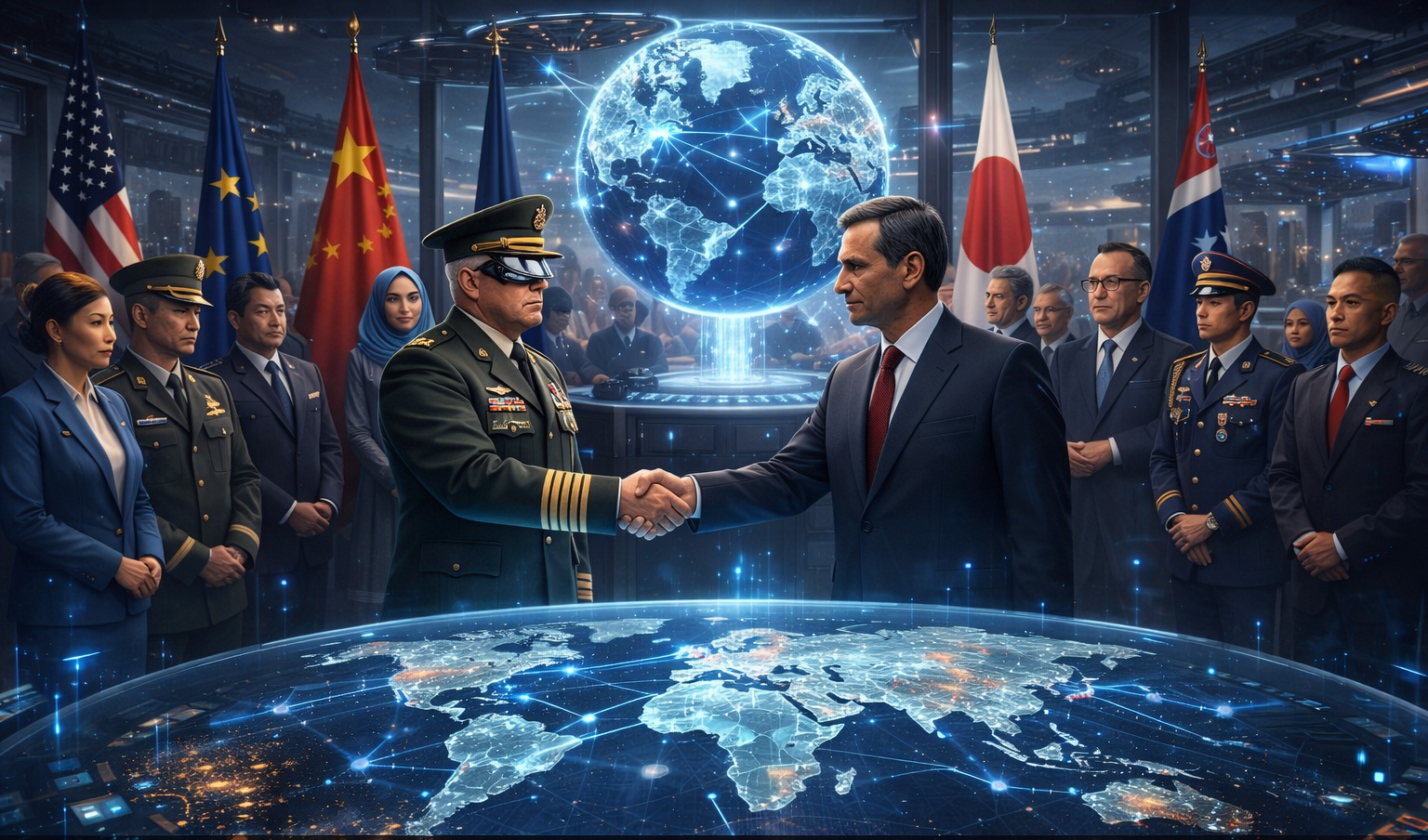
One founding ally provided critical support during the contested era when VMSS's military capability had not yet matured. That relationship carries historical weight and remains the closest bilateral partnership in the alliance structure.
A mutual defense obligation binds treaty members. An attack on any allied civilization triggers collective response. This obligation is what prevents rival superpowers from targeting smaller allied states individually.
Citizens may emigrate freely between allied civilizations. A Sanctuary resident who prefers a six-ring system may relocate. This free movement signals that VMSS does not claim to be the only valid model — only its own.
Border Protocol — Layer Equivalence Mapping
Allied civilizations operate gradient governance models with different numbers of rings and different behavioral thresholds for each layer. When citizens cross between allied systems, a layer equivalence mapping governs placement. Lower layers bridge to their equivalents: a -1 equivalent in a four-ring system maps to VMSS -1. A terminal-layer equivalent maps to VMSS -3. Upper layers map to upper layers. The mapping is structural — published in each bilateral treaty and applied mechanically at every border crossing. No case-by-case adjudication, no diplomatic negotiation over individual citizens.
Every allied citizen entering VMSS undergoes a ledger audit at the border. VMSS reads the behavioral record and applies its own thresholds independently. If the allied system's classification matches the VMSS equivalent — the citizen enters at the mapped layer. If the allied system classified the citizen more leniently than VMSS would — the citizen's entry is denied. They return to their home system where they remain in good standing. VMSS does not place allied citizens in lower layers they did not earn through VMSS's own behavioral thresholds. Placing an allied citizen with a clean home-system record into -1 because of a classification mismatch would violate the foundational principle that pairing the innocent with the harmful is a design failure. Entry denial is the cleaner instrument: VMSS's integrity is maintained, the ally's sovereignty is respected, and no innocent person inhabits a punitive environment.
The diplomatic consequence is passive but persistent. When an allied citizen is turned away at the VMSS border, the ally must explain why their classification did not meet VMSS's standard. Over time, this creates calibration pressure — allies either tighten their thresholds toward VMSS's or accept that their citizens face entry restrictions. The border functions as a passive standards instrument without VMSS ever issuing a directive about how an allied civilization should govern.
Diplomatic Corps
VMSS maintains permanent embassies in allied nations and selective diplomatic presence in non-allied states where strategic engagement is active. Ambassadors are drawn from the Meritboard — diplomatic representation is an executive function, credentialed by the same measurable competence that governs all senior appointments. An ambassador carries the President's authority in their jurisdiction and operates under direct executive mandate.
Embassy staff include AI governance liaisons who manage implant interoperability, ledger synchronization, and border protocol coordination with the host nation. In allied countries, embassy infrastructure includes cross-platform implant servicing — allied citizens preparing to visit VMSS can undergo pre-clearance and ledger audit at the embassy before reaching the border. In hostile nations, VMSS maintains no embassy. Diplomatic communication is routed through neutral intermediaries or conducted at the border zone itself.
Data-Sharing with Allies
Allied nations receive layer placement data and ledger summaries sufficient for border protocol, diplomatic functions, and extradition verification. This transparency enables the layer equivalence mapping that governs cross-border citizen movement and allows allies to verify that fugitives absorbed into VMSS are placed in the layer their conduct warrants.
Raw behavioral telemetry, biometric specifics, and surveillance-grade data are sovereign. VMSS does not share the granular behavioral record that the implant captures — only the classification output that record produces. An ally can verify that a citizen is placed in -1. It cannot access the specific behavioral data that produced the placement. This boundary is non-negotiable: VMSS does not recognize foreign jurisdiction over its citizens' behavioral data any more than it recognizes foreign jurisdiction over its citizens' bodies. Treaty membership grants transparency into outcomes, not access to the surveillance infrastructure that generates them.
The Broader Landscape
Beyond the alliance, the geopolitical landscape includes rival superpowers operating under fundamentally different governance philosophies, a spectrum of smaller states ranging from VMSS-aligned to hostile, and neutral parties with no structural affiliation.
VMSS engages diplomatically by choice. Its fabrication technology and automation infrastructure make full self-sufficiency achievable. It chooses trade, alliances, and international presence because engagement serves its interests — not because isolation is impossible.
Alliance Diversity & VMSS-Adjacent Nations
The alliance is not a bloc of copies. Every allied civilization adopted gradient governance, but each calibrated the model to its own founding conditions, cultural tolerances, and philosophical commitments. The result is a constellation of structural variations operating under a shared treaty framework — sovereign experiments running in parallel, producing comparative data that no single civilization could generate alone.
Ring count varies. Some allies govern through four rings, others through six. A four-ring system compresses the behavioral gradient — fewer layers, broader populations per ring, coarser consequence resolution. A six-ring system expands it — finer behavioral distinctions, more granular placement, but greater administrative complexity. Neither is inherently superior. Each produces a different cost profile, and the alliance benefits from observing both.
Enforcement posture diverges. Not every allied nation adopted the killswitch or nanobot plume architecture that VMSS considers foundational to its lower-layer containment model. Some allies view lethal enforcement technology as incompatible with their founding values and govern their terminal layers through surveillance saturation, economic restriction, and physical containment alone. Others adopted the killswitch but declined nanobot plumes, accepting higher enforcement latency in exchange for what they consider a more proportionate security posture. These are not treaty violations — the Federation Treaty mandates gradient governance, mutual defense, and layer equivalence mapping, not specific enforcement mechanisms. An ally's internal security architecture is sovereign.
Permanence is not universal. VMSS treats punitive reassignment as permanent — no upward pathway, no parole, no rehabilitation exception. Several allied nations diverge here. Some implement measured recovery systems where punitive residents can demonstrate sustained behavioral reform over decades and earn upward reassignment through STI-verified milestones. Others apply permanence to their terminal layer but allow recovery from intermediate layers. The philosophical tension is genuine: permanence produces residents who build lives rather than count down clocks, but recovery systems produce residents with an active incentive to demonstrate reform. Both generate measurable outcomes. The alliance framework treats this as a policy variable, not a doctrinal litmus test.
VMSS-adjacent nations push further. Beyond the formal alliance, a category of nations exists that adopted gradient governance principles without signing the Federation Treaty — either because they diverge too far from treaty standards or because they prefer sovereignty without mutual defense obligations. These adjacent nations experiment with structural variations that the alliance framework would not accommodate: full cognitive transparency through implant telemetry, democratic governance layered onto ring architecture, universal autoparenting systems, or revival technology with different fidelity-continuity tradeoffs. They are not allies, but they are not hostile. They are neighbors running experiments that VMSS watches with clinical interest.
The diversity is functional, not accidental. Every allied variation from traditional VMSS produces measurable costs and benefits. A nation that softens permanence generates data on recidivism rates, resident investment patterns, and cross-layer mobility that VMSS has never needed to produce — because VMSS made the opposite choice. A nation that drops the killswitch generates data on enforcement latency and lower-layer stability without lethal containment. Collectively, the alliance operates as a distributed experiment: each member tests a different configuration of the same foundational principles, and the comparative performance data either validates the traditional model or reveals where it could be improved. VMSS benefits from both outcomes. Validation confirms existing doctrine. Improvement data refines it. The alliance is not a concession to pluralism — it is a research instrument that requires sovereign diversity to function.
Brain Drain & Talent Arbitrage
VMSS does not restrict aspiration migration to accommodate foreign retention policies. If a nation's most talented citizens choose to relocate to VMSS, that is an evaluation of their origin civilization, not an act of predation by the destination. The founding migration was driven entirely by aspiration rather than desperation — and the pattern continues. VMSS does not recruit, does not offer incentive packages, and does not target specific populations. It publishes its doctrine, maintains its quality of life, and allows self-selection to operate.
The doctrinal response to brain drain accusations is structural: treaty membership is the cure. Allied nations receive technology transfers — advanced diagnostics, fabrication-grade pharmaceuticals, automation infrastructure — that raise their own quality of life and reduce the emigration incentive. A nation losing talent to VMSS can either improve its own conditions or join the treaty framework that gives it access to the tools for improvement. Blaming VMSS for being the better offer is a diplomatic posture, not a policy argument. The civilization accepts the accusation and does not modify its immigration architecture in response.
5. International Travel
The technoneural implant serves as a citizen's passport. No separate documentation is required. The implant remains active during international travel — it continues recording behavioral data, and the citizen's status updates in real time across VMSS systems.
Travel Authorization
Travel is visa-based, following standard international durations. Citizens in the upper layers travel broadly. Lower layer residents travel from a restricted list of approved destination countries — the specific list determined in part by the destination country's own admission policies.
Return Processing
Upon return, border processing is the implant syncing with domestic systems. Any qualifying conduct committed abroad is already on the ledger. Reassignment follows the same severity-based evaluation applied to domestic offenses. Visa overstay may escalate consequences.
Lower Layer Travel Restrictions
International travel privileges scale with layer placement. Main Layer and +1 Sanctuary citizens travel broadly under standard visa arrangements. -1 Noncompliance residents may travel internationally from a restricted list of approved destinations — countries with bilateral monitoring agreements that ensure implant continuity and ledger synchronization throughout the visit. Travel authorization requires federal review and the implant remains under active surveillance for the duration.
-2 Violent Offense residents do not travel internationally. The behavioral profile that placed them in -2 — predatory violence — represents an unacceptable liability in foreign jurisdictions where VMSS enforcement infrastructure does not operate. No destination country is obligated to accept the risk, and VMSS does not export it.
-3 Terminal residents do not travel. The backup vessel link is severed, the implant may be disabled or removed, and VMSS has withdrawn institutional oversight. International travel requires the infrastructure -3 residents no longer carry. The border is sealed in both directions for terminal placement.
Implant integrity abroad: Attempted removal or disabling of the implant outside VMSS borders triggers hardware-level failsafes. The citizen is recovered via drone and returned to VMSS territory for processing.
6. Foreign Citizens in VMSS
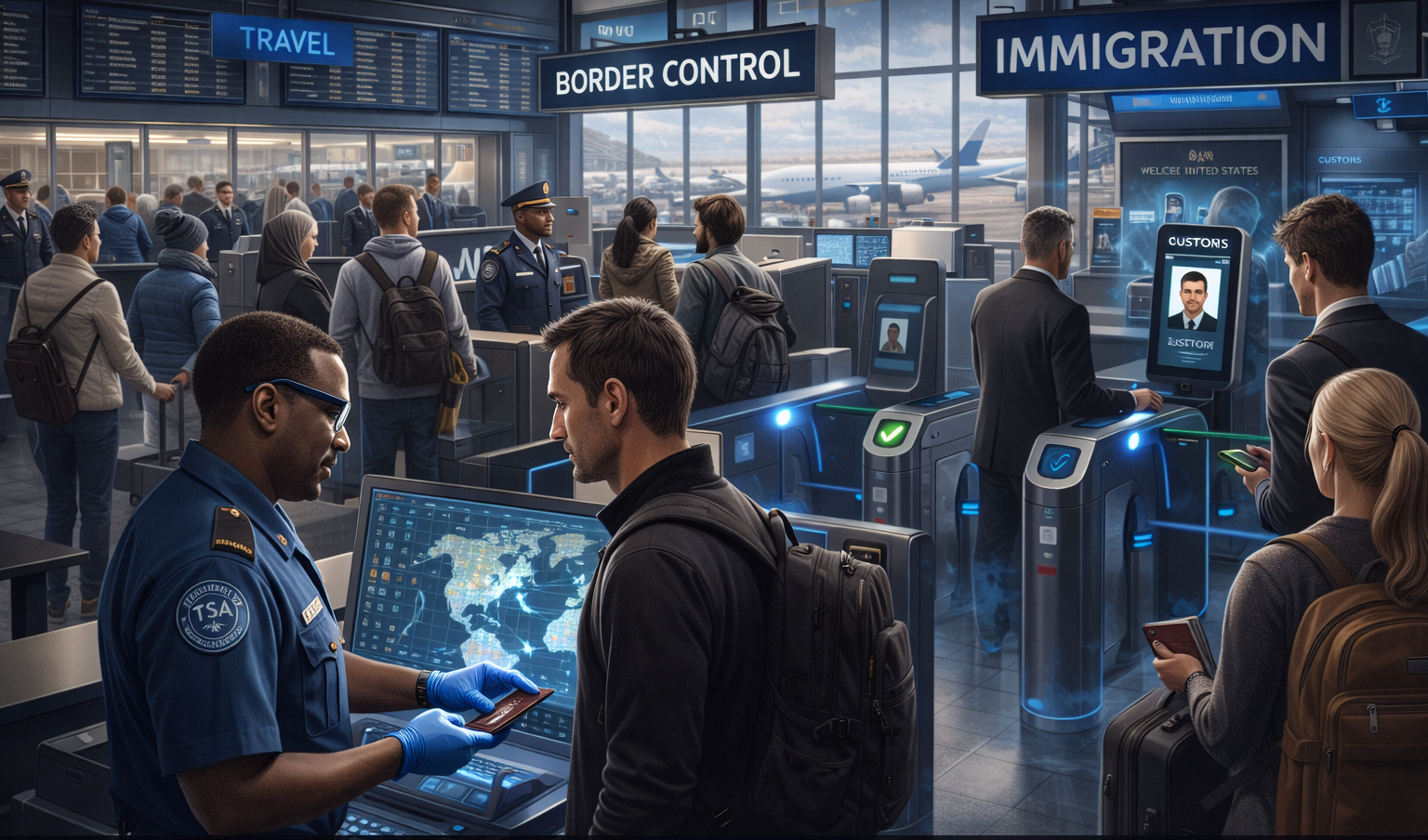
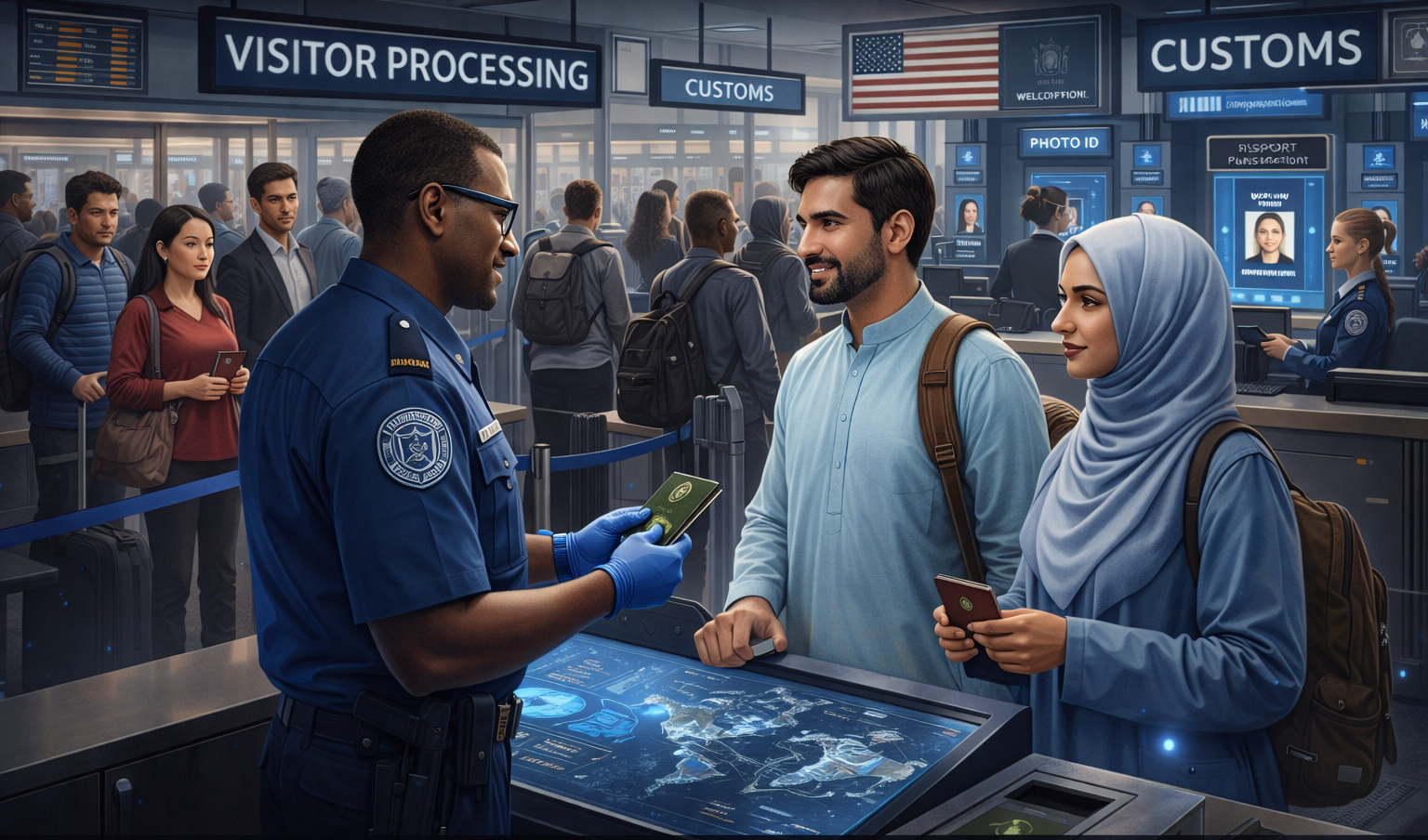
Citizens from allied civilizations entering VMSS territory carry implants with cross-platform compatibility. Their devices are recognized by VMSS systems, enabling standard movement and identification within the civilization.
Allied Visitors
Cross-platform implant compatibility enables seamless entry. Allied citizens are recognized by VMSS infrastructure and move freely under treaty terms.
Non-Allied Visitors
Visitors from non-allied or non-implant civilizations enter under sovereign law. No implant is required — but without one, they operate under external monitoring infrastructure: drone patrol and AR telemetry. A visitor implant is available but not mandated.
Permanent Immigration
Anyone may apply for VMSS citizenship. There is no population cap, no ethnic criterion, no ideological test. The gatekeeping mechanism is behavioral sorting, not admission scarcity. Applicants undergo a full background evaluation using documented conduct and all available behavioral data — not foreign conviction records alone, which the doctrine elsewhere recognizes as probabilistic, politically contested, and unreliable. The AI governance system evaluates the totality of available evidence: foreign criminal records, documented conduct patterns, witness testimony, publicly available behavioral data, and any allied implant records where applicable. Where foreign evidence is ambiguous or potentially fabricated — a dissident fleeing a hostile state whose record alleges capital crimes — the system defaults to Main Layer placement with immediate implant monitoring. The implant begins recording from the moment of installation. If the applicant's conduct within VMSS triggers the multi-factor evaluation, their behavioral trajectory under implant observation becomes the evidentiary foundation — not the foreign record they arrived with. The system resolves evidentiary uncertainty through observation, not through trust in foreign institutions it does not control. A clean foreign record places the applicant in Main Layer. A credibly documented criminal record maps to the appropriate lower layer using severity-based evaluation. The applicant is informed of their projected placement before accepting — no one enters VMSS without knowing where they will live.
Upon acceptance, the applicant receives a technoneural implant, undergoes orientation processing, and enters their assigned layer with full citizenship rights and obligations from day one. Asset conversion follows standard liquidation protocols — external wealth is converted to VMSS currency at assessed value, subject to the same SCM and taxation framework as domestically earned income. Family immigration is processed collectively — dependents are evaluated individually, and children are placed in Main Layer regardless of parental placement, consistent with the charter's protection of children from parental consequence.
Refugee & Asylum Protocols
VMSS accepts refugees from any nation, including hostile states. The humanitarian floor that guarantees no layer permits starvation extends to people seeking entry under duress. Refugee processing follows the same intake standard as standard immigration — the totality of documented conduct and available behavioral data, with ambiguous or politically contested evidence defaulting to Main Layer placement with immediate implant monitoring. Fleeing persecution does not alter the evidentiary standard in either direction. A refugee with a clean record enters Main Layer. A refugee with credibly documented criminal conduct is placed according to severity-based evaluation. A refugee whose record originates from a hostile state that may have fabricated charges enters Main Layer under observation — the implant resolves the evidentiary uncertainty through domestic observation. The system does not punish people for fleeing harm, and it does not waive behavioral thresholds because someone arrived under sympathetic circumstances.
Asylum claims from citizens of allied civilizations are handled through bilateral treaty channels — the allied system is notified, and the circumstances that produced the asylum request become part of the diplomatic calibration record. Asylum claims from hostile states carry no diplomatic obligation — VMSS processes the applicant and does not notify the origin country. Accepting refugees from hostile nations is not treated as a provocative act. It is treated as a standing human right that requires no justification.
Foreign Births & Parentage
A child born abroad to a VMSS citizen is eligible for VMSS citizenship by parentage. The parent registers the child through embassy infrastructure in allied nations or through diplomatic channels in non-allied states. Upon registration, the child is assigned Main Layer regardless of parental placement — consistent with the charter's protection of children from parental consequence. Implant installation occurs when the child enters VMSS territory. Until that point, the child lives under foreign jurisdiction with VMSS citizenship pending.
A VMSS parent who chooses not to register their child does not extinguish the child's eligibility. The child's constitutional rights under VMSS law — citizenship, UBI eligibility, legal advocacy, relocation to Main Layer — exist from birth by parentage. Registration is not what creates these rights. It is what activates VMSS's enforcement infrastructure to protect them. A non-registered child's rights are inherent but dormant: they cannot be enforced extraterritorially in a foreign sovereign nation for a child VMSS has no jurisdictional contact with. The moment that child contacts any VMSS infrastructure — embassy, border checkpoint, allied implant network, diplomatic channel — the full rights package activates immediately and retroactively. The parent's omission delays enforcement. It does not suppress the underlying right. Registration is the standard pathway. Self-presentation at any VMSS contact point is the backstop. A child registered but not yet implanted carries provisional citizenship status: VMSS recognizes them as a citizen for diplomatic purposes, but full integration — ledger activation, UBI eligibility, backup vessel linkage — begins at implant installation.
7. Jurisdiction & Prosecution
VMSS citizens who commit offenses abroad are subject to the laws of the country they are in. The civilization does not intervene in foreign legal proceedings. Citizens travel at their own risk.
Upon return, the implant ledger is current. Any qualifying offense triggers reassignment under standard severity-based evaluation, independent of whether the foreign country prosecuted.
Recall Protocol
Citizens flagged for recall receive a voluntary return window. If the window expires, recovery is enforced. The civilization distinguishes four escalation categories:
- Recallable citizen — flagged for return, voluntary window still open. Standard diplomatic channels.
- Enforced recovery — voluntary window expired. VMSS pursues retrieval through escalating diplomatic pressure.
- Hostile shelter — a foreign state actively harboring a recalled citizen. Treated as a diplomatic affront; sustained refusal escalates to sovereignty-level response.
- Sovereignty breach — a foreign state using a VMSS citizen as leverage, intelligence, or political instrument against recall. Treated as an act against VMSS sovereignty.
Revival Abroad
Revival of citizens killed abroad is handled through digital transmission to backup vessels within VMSS territory. The body is not required for revival but aids morphological reconstruction — physical retrieval is pursued when diplomatically feasible.
Citizenship Revocation
Citizens who voluntarily revoke VMSS citizenship abroad are released from all obligations and protections. They become former citizens — no longer subject to recall, reassignment, or civilizational protection. The distinction is clean: a former citizen is not a fugitive. They chose to leave, and the civilization honors that choice by releasing them entirely.
Revocation cannot be processed while an active recall or enforcement action is pending. The implant ledger records qualifying conduct instantaneously — the recall attaches at the moment of the act, not at the moment of physical recovery. A citizen who commits a qualifying offense abroad and subsequently attempts to revoke citizenship discovers that the recall queue takes precedence over the administrative queue. The revocation request is held until the enforcement action resolves: the citizen is recovered, returned to VMSS territory, and processed through standard severity-based reassignment. Only after consequence delivery is complete can the citizen file for revocation from their assigned layer. Consequence cannot be evaded by resigning from citizenship while the system is already in motion — the sequence is act, consequence, then exit if desired. Not act, exit, consequence avoided.
Upon revocation, the implant is removed and all hardware-level systems are deactivated. The former citizen retains whatever knowledge they acquired during their time in VMSS — and this is not a security concern. The constitutional framework, layer mechanics, governance model, and enforcement architecture are published openly. A departing citizen knows exactly what every reader of the doctrine portal knows. Military operational specifics are classified and compartmentalized — a standard citizen never had access. Implant and fabrication technology is sovereign hardware engineering, not transferable knowledge. A former citizen cannot replicate VMSS infrastructure any more than a former airline passenger can build a jet engine. The civilization's security rests on architectural superiority, not on secrecy.
Extradition
VMSS does not extradite. A foreign national who enters VMSS territory — whether as an immigrant, a refugee, or a fugitive — is processed through the same intake standard described above: the totality of documented conduct and available behavioral data, not foreign conviction records alone. Where the foreign evidence is credible and corroborated — allied nations with implant-compatible ledger data, multiple independent sources confirming the same conduct pattern — the AI governance system places accordingly. Where the foreign evidence is ambiguous, politically contested, or originates from a hostile state with documented history of fabricating charges — the applicant enters Main Layer with immediate implant monitoring. The system does not trust foreign adjudication enough to place someone below Main on foreign evidence alone. It trusts its own instruments. The implant resolves what foreign courts cannot: whether the person's behavioral trajectory, observed under VMSS's own infrastructure, confirms or contradicts the record they arrived with.
The diplomatic response to extradition requests is consistent: the individual has been absorbed into the VMSS consequence system. If the foreign evidence was credible, the individual is already in the layer their conduct warrants. If the evidence was ambiguous, the individual is in Main Layer under observation — and if their conduct confirms the foreign record, the system will place them accordingly through domestic evaluation. The foreign nation may view this as insufficient — their courtroom was denied its proceeding. VMSS views it as sufficient — placement follows observed conduct, not foreign claims. For allied nations, extradition refusal is softened by the transparency of the placement: the ally can verify through ledger access that their fugitive is living in the layer their conduct warrants. For hostile nations, no explanation is offered.
Dual-Citizenship
VMSS does not prohibit its citizens from holding foreign citizenship. It also does not recognize foreign citizenship as relevant within its borders. The implant makes you a VMSS citizen. Foreign governments may claim you simultaneously — VMSS is indifferent to the claim. On VMSS soil, VMSS law applies exclusively. Abroad, the citizen is subject to local law, as stated in the general jurisdiction doctrine above. There is no treaty obligation to coordinate with foreign citizenship claims, no mechanism for a foreign government to override VMSS jurisdiction by invoking dual nationality, and no diplomatic channel through which a foreign state can demand that VMSS enforce its conscription, taxation, or custody orders against a VMSS citizen.
If a foreign military draft conflicts with VMSS residence, that is the citizen's problem to resolve — not a diplomatic crisis. VMSS does not force citizens to remain in its territory, but the implant stays active wherever they go. A citizen who fulfills foreign military service abroad accumulates that conduct on their own ledger. If the conduct involves qualifying offenses under VMSS thresholds, reassignment follows upon return. Dual citizenship is the citizen's administrative complexity to manage. VMSS treats every implanted person as a VMSS citizen, full stop.
Mixed-Jurisdiction Families
Marriage exists in VMSS as a legal institution — a contractual framework between consenting parties, registered through standard civil infrastructure. VMSS recognizes marriages performed on its soil under its own law and recognizes foreign marriages of VMSS citizens as legally valid upon registration. Divorce jurisdiction follows residency: if both parties live in VMSS, VMSS law governs. If one party is a VMSS citizen and the other is foreign, each party may file in their own jurisdiction — VMSS does not attempt to reach into foreign courts, and does not recognize foreign court authority over VMSS-resident assets or VMSS-resident citizens.
Custody is where the doctrine sharpens. For allied nations with gradient governance and comparable infrastructure, foreign custody rulings are recognized through bilateral treaty — the Hague principle of habitual residence applies, and custody follows the child's primary home. For non-allied nations, VMSS treats custody disputes the same way it treats extradition: the foreign court's ruling is a diplomatic matter, not a legal obligation. A child who is a VMSS citizen cannot be placed into an environment below VMSS's humanitarian floor through foreign custody order. If a foreign court grants sole custody to a foreign parent in a jurisdiction where the child would lose implant continuity, backup vessel access, UBI, and medical drone coverage — VMSS does not comply. The child's civilizational protections are not negotiable by foreign court order. This is not a custody preference. It is a constitutional constraint.
Foreign Offenders Abroad
When a foreign national harms a VMSS citizen outside VMSS territory and returns to a non-cooperative jurisdiction, the doctrinal response is systemic, not operational. VMSS does not conduct extraterritorial operations against foreign nationals — that would require assassination or kidnapping, neither of which is doctrinal. The response follows the same passive, cumulative logic that governs all VMSS diplomatic instruments.
The offender is permanently border-denied — they will never enter VMSS or allied territory for the remainder of their life. If the home country refuses accountability for the offense, the harboring state accumulates on the sanctions tier ladder — the same escalation logic applied to hostile shelter in the recall protocol. Sustained refusal to provide justice for harm against VMSS citizens is treated as diplomatic friction that compounds over time, not as an individual criminal matter. If the offender ever enters VMSS soil or allied territory under treaty coordination, they are processed through standard behavioral evaluation and placed in the layer their conduct warrants. The leverage is passive and permanent. VMSS does not forget, and the border never reopens.
8. Trade & Currency
VMSS currency is inconvertible. It does not circulate outside the civilization's borders.
| Relationship | Trade Terms | Access Level |
|---|
| Alliance Treaty Partners | Preferential | Full technology and infrastructure access |
| Non-Allied States | Standard bilateral | Goods-based trade, selective technology |
| Hostile States | Tariffed | Restricted, case-by-case |
International trade is goods-based. VMSS exports technology, automation infrastructure, medical systems, and fabricated materials.
The civilization's self-sufficiency is total — orbital and spacecraft assets, energy independence, and automated production eliminate any material dependency on foreign supply chains. VMSS trades because engagement serves its strategic interests, not because it requires foreign goods to function.
VMSS Production
Orbital fabrication stations, automation, medical systems, advanced materials
→
Goods-Based Export
Technology, infrastructure, and fabricated materials. No currency leaves the borders.
→
Trade Partners
Allies receive preferential access. Non-allied at standard terms. Hostile states tariffed.
Sanctions Architecture
VMSS sanctions are not economic pressure campaigns in the Earth sense — they do not depend on financial system exclusion or currency manipulation. They operate through technology withdrawal. The civilization's self-sufficiency makes it immune to counter-sanctions. Its proprietary technology makes its exports irreplaceable.
Sanctions escalate across three tiers:
| Tier | Trigger | Response |
|---|
| Tier 1 — Diplomatic Friction | Sustained policy divergence, border denial accumulation, refusal to meet behavioral reciprocity standards | Technology export restrictions. Medical system upgrades withheld. Infrastructure contracts suspended. Trade continues on standard terms for non-restricted categories. |
| Tier 2 — Active Hostility | Espionage against VMSS infrastructure, harboring VMSS fugitives, military posturing at border zones | Full technology embargo. Fabrication proxy access revoked. Medical supply chain severed. Goods-based trade restricted to humanitarian essentials only. Border sealed to all non-emergency traffic. |
| Tier 3 — Civilizational Threat | Direct military aggression, weapons of mass destruction deployment, coordinated cyberattack on VMSS infrastructure | National defense track activates. Military response authorization. All trade terminated. The response is overwhelming by design and temporary by doctrine — VMSS has no interest in occupation or regime change, only in neutralising the threat and restoring the border. |
The decisive leverage is biological. VMSS citizens live 200–300 years with full cognitive integrity. Longevity augmentation is proprietary technology that does not leave VMSS borders. Allied nations receive medical technology transfers — advanced diagnostics, fabrication-grade pharmaceuticals, infrastructure-grade automation — but never the longevity stack itself. A Tier 1 sanction withdrawing medical technology transfers is not a symbolic gesture. It is the removal of healthcare infrastructure that the sanctioned nation cannot replicate independently. The asymmetry is not a policy instrument — it is a physical reality created by technology that no external power possesses.
Sanctions are passive, cumulative, and self-escalating. VMSS does not issue ultimatums or negotiate sanction relief through diplomatic concessions. The sanctioned nation's own citizens generate the internal pressure — as border denials accumulate, as medical technology degrades without updates, as the gap between VMSS living standards and their own becomes undeniable. The calibration pressure is generated by reality, not by rhetoric. VMSS never raises its voice.
Trade Dependency
When a foreign nation becomes strategically dependent on VMSS exports — medical systems, automation infrastructure, fabricated materials — VMSS holds leverage that operates independently of formal sanctions. This is not a weaponized policy. It is a natural consequence of technological superiority. The Tier 1 sanctions architecture withdraws technology exports — and that mechanism only works because the dependency already exists. VMSS does not engineer dependency. It produces irreplaceable goods, and dependency follows.
The asymmetry is self-reinforcing: the longer a nation trades with VMSS, the deeper its infrastructure integrates VMSS technology, and the more disruptive withdrawal becomes. A nation that has run its hospital network on VMSS medical systems for two decades cannot switch to inferior domestic alternatives without measurable loss of life. This is not coercion — it is reality. The solution, as with every other diplomatic pressure point, is treaty membership. Full allies receive technology transfers with integration support, reducing single-point dependency. Nations that trade without joining accept the structural risk of depending on exports they cannot replicate.
Sanctions Through Third Parties
Adversaries who cannot sanction VMSS directly — because VMSS is self-sufficient and immune to supply chain disruption — may attempt indirect isolation: pressuring neutral states, insurers, logistics providers, or orbital corridor partners to cut ties with VMSS. The strategy fails on the same asymmetry that makes direct sanctions ineffective. A neutral state pressured to choose between VMSS and a hostile power is choosing between irreplaceable technology access and replaceable diplomatic relations. VMSS medical systems, fabrication exports, and automation infrastructure have no substitute. The hostile power's pressure does.
Over time, third-party sanction strategies collapse because compliance costs exceed defiance costs for every neutral actor in the chain. An insurer that refuses VMSS-linked contracts loses the most profitable portfolio in its book. A logistics provider that reroutes around VMSS corridors adds cost that competitors who maintain VMSS relations do not carry. Each actor's individual rational calculation favors maintaining VMSS trade — and the hostile power cannot subsidize every actor in the chain indefinitely. The strategy is structurally unwinnable.
Transit Rights
VMSS airspace and territorial waters are sovereign. No blanket transit rights exist. Allied nations may request transit under bilateral treaty terms — passage is granted through designated corridors with advance notification, implant-verified crew manifests, and real-time tracking for the duration of transit. Non-allied nations may request transit on a case-by-case basis through diplomatic channels. Hostile nations are denied transit without exception. Unauthorized entry into VMSS airspace or territorial waters by any state is treated as a sovereignty violation and escalated to the appropriate tier of the sanctions architecture — or to the national defense track if the incursion is military in character.
9. Information
Information flows freely in and out of The Five Rings. VMSS citizens access foreign media without restriction. Foreign journalists and media organizations are not barred from reporting on the civilization.

VMSS does not control its narrative through censorship. It controls it through institutional education and the strength of its public doctrine.
Confidence Replaces Concealment
Every Earth government maintains classified information on the theory that transparency creates vulnerability. VMSS inverts this. The civilization publishes its constitutional framework, enforcement architecture, layer mechanics, and governance structure openly — not because it has nothing to hide, but because the architecture is stronger when understood. A system that requires ignorance to survive is a system with structural weaknesses it cannot fix without exposing them. A system that publishes everything and still functions has no structural weaknesses that knowledge can exploit.
This is not naïveté. Military operational specifics remain classified. Intelligence methods are not published. But the doctrine — the rules, the logic, the consequences, the governance model — is fully public. Foreign governments know exactly how VMSS works. Foreign citizens know exactly what they would be joining. Foreign critics know exactly what they are criticizing. This eliminates the most common attack vector against any new civilization: the accusation that it hides its true nature. VMSS has no hidden nature. The doctrine portal you are reading is itself the proof.
The strategic advantage is counterintuitive: full doctrinal transparency makes the civilization harder to attack, not easier. Disinformation campaigns fail because citizens can verify claims against published source material. Defection narratives fail because prospective members already know the full architecture before entry. Diplomatic leverage fails because there is no secret to threaten exposure of. Concealment is a liability masquerading as an asset. Confidence is the asset itself.
The doctrine portal you are reading is itself an expression of this principle. VMSS publishes its own constitutional framework, enforcement logic, and civilizational architecture openly. Confidence replaces concealment.
Foreign Platform Governance
Foreign social, financial, and communications platforms may operate inside VMSS without content regulation or moderation mandates imposed by VMSS governance. Information flows freely — this principle applies to foreign platforms the same way it applies to domestic media and foreign journalism. VMSS does not censor, does not impose identity verification requirements beyond what sovereign law requires of every entity on its soil, and does not dictate how a foreign platform moderates its own content.
The doctrinal logic is straightforward: VMSS enforcement does not depend on platform cooperation. The implant records behavioral data at the hardware level regardless of what platform the behavior occurs on. If a citizen commits a qualifying offense through a foreign platform — coordination attacks, network-attributed harm, threshold-crossing conduct — the ledger captures it independent of the platform's moderation policy. The platform is irrelevant to consequence delivery. VMSS does not need to control the medium because it controls the behavioral record at the source. The one constraint is sovereign law: foreign platform operators on VMSS soil are subject to the same behavioral evaluation as any individual. A platform whose operations facilitate qualifying offenses under VMSS thresholds — coordination attacks detectable through network attribution, for instance — exposes its operators to the same ledger consequences as any other participant in the network.
10. Culture & Embodiment
In a civilization where biological augmentation is advanced and widely accessible, baseline appearance becomes editable. Facial symmetry, body composition, age presentation, voice, and physical form are no longer fixed by genetics — they are choices, constrained primarily by cost and layer access.
This eliminates involuntary ugliness as a civilizational condition. But it does not eliminate status hierarchy. It mutates it. The old axis of "attractive vs. unattractive" gives way to a more layered gradient of origin legitimacy:
Origin Purists
Prize untouched inheritance and unbroken natural lineage. View unmodified form as authentic and engineered beauty as manufactured. Over long time horizons, may concentrate into Lineage Integrity Domains within Sanctuary — high-trust enclaves where genetic purity is institutionally verified.
Self-Authorship Modernists
Believe chosen embodiment is more meaningful than inherited luck. View editing yourself as agency, not shame. Philosophically aligned with the civilization's emphasis on self-determination.

A third category — dynastic optimizers — quietly builds lineages of inherited engineered advantage and presents the result as natural. A child born from optimized parents can honestly say "I was born this way" while carrying engineered traits. That collapses the natural/altered distinction entirely and creates what amounts to a bio-aristocracy with plausible deniability.
The cultural consequence is significant. Beauty becomes less about luck and more about choice, wealth, and origin story. Taste variation explodes while ugliness declines. Neglect becomes more socially legible — in a world where improvement is widely available, poor self-presentation reads as a signal rather than a circumstance.
The technology flattens biological luck, but not the human instinct to rank. Status hierarchies do not disappear in VMSS — they evolve. What counts as "authentic," "tasteful," or "earned" becomes the new axis of social distinction, replacing the genetic lottery that governed appearance for all of prior human history.
Founders' Day
Once per civilizational year, every public commons in all five rings displays the four founding lines from the Charter preamble. In Sanctuary, the observance is a live consensus reading — roughly three hundred million voices, synchronized by neural timing across every Founders' Gate in the ring, speaking the four lines in the original script. The reading is not legally required. Attendance is not tracked. The observance persists because the civilization keeps choosing to hold it, generation after generation, for the same reason residents keep walking the long way past the ring stones: the four lines do nothing on their own, and everything in the presence of the people who read them.
In Main Layer, Founders' Day is quieter and more varied. Some districts hold public readings. Some mark the day only by displaying the lines on civic infrastructure. Some treat it as a family observance, reading the four lines at the morning meal and letting the children ask what they mean. The lower layers mark the day through whatever private and civic forms they have organized, outside institutional direction. The civilization has never standardized the observance. The four lines do not need a standard form to be honored.
11. Entertainment & Sensory Culture

The technologies described elsewhere on this site — neural diving, biological augmentation, backup vessels, fabrication, AGI — are framed as governance infrastructure. They are also the foundation of an entertainment and cultural landscape that no Earth civilization can produce. This section describes what VMSS citizens actually do with their time.
Gaming
UBI eliminates the "you need a real job" stigma. The Primary Job Subsidy means 20-hour work weeks. Competitive and recreational gaming is not a niche subculture — it is a mainstream lifestyle with institutional legitimacy and civilizational-scale audiences. Denmark's thriving esports scene, produced by shorter work weeks and extra vacation time alone, is a proof of concept at a fraction of VMSS's scale. In VMSS, gaming communities operate with full economic viability, professional infrastructure, and cultural visibility comparable to any traditional sport. Neural diving spectator integration (below) transforms the viewing experience beyond anything Earth broadcasting can offer.
ImmersionTube & Full Sensory Media
Neural diving is a recording medium. If you can stream sensory experience between two brains in real time, you can capture it, edit it, and distribute it. ImmersionTube is the platform: full sensory media — audio, vision, taste, touch, smell, proprioception, emotional tone — in a single playable format. A cooking show where you taste the dish. A nature documentary where you feel the altitude. A concert where the crowd's collective energy is part of the experience. Film captures two senses. Music captures one. ImmersionTube captures all of them simultaneously. Every prior media format becomes a subset of what this platform delivers.
Sensory Art
ImmersionTube records reality. Sensory artists compose original experiences from scratch. A piece that is a 20-minute emotional arc — warmth building to euphoria, the taste of copper, the smell of rain, vertigo, relief — composed deliberately like a symphony but across every sense simultaneously. No visual component required. Pure synesthesia as creative medium. Painting uses vision. Music uses hearing. Sensory art uses everything. This is an entirely new art form with no Earth analog, enabled by the same neural diving infrastructure that powers empathy education and counter-radicalization.
Neural Diving Spectator Sports
Watch a football game from inside the quarterback's body. Feel the hit, feel the catch, feel the adrenaline spike on a game-winning drive. Not a camera angle — the athlete's actual sensory experience streamed through neural diving to millions of audience-mode viewers simultaneously. Sports broadcasting becomes a full-body experience. This makes every Earth broadcasting technology look like radio. Athletes who consent to audience-mode streaming during competition become the most intimate performers in human history — their audience doesn't watch them play; their audience is them, for the duration of the game.
Extreme Sports Without Permanent Death
Backup vessels fundamentally change the risk calculus. Base jumping without a parachute. Free solo climbing where a fall means revival, not a funeral. Racing at speeds that would be suicidal on Earth. Combat sports with lethal outcomes where both fighters walk away after revival. The thrill and pain are completely real — the implant does not numb the experience. But the consequence ceiling is a revival bay, not a casket. This creates entire categories of sport that Earth cannot have — competitions where the physical stakes are genuinely lethal and the permanent stakes are zero. The cultural appetite for this is predictable: humans have always pushed physical limits. VMSS removes the ceiling.
Immortal Art
Artists who live 200–300 years create works with timescales impossible on Earth. A sculptor who spends 80 years on a single piece. A novelist whose series spans a century of lived experience and evolving perspective. A musician whose discography covers 250 years of stylistic evolution — and fans who have been following them the entire time, because both artist and audience persist. Art acquires depth that mortality makes impossible. The relationship between artist and audience spans lifetimes rather than careers. A painting started in 2050 and finished in 2130 carries 80 years of visible artistic development within a single work.
Memory Libraries
If neural diving can record experience, you can archive it. A public library of preserved first-person experiences spanning centuries. Experience what the Founding Treaty felt like from someone who was there — not a dramatization, the actual recorded experience. Relive a historical battle from a soldier's perspective. Walk through a city that was demolished 200 years ago, in the sensory memory of someone who lived there. Education, entertainment, and historical preservation fused into one medium. "Reading history" becomes "living history." The archive compounds over centuries — each generation adds its experiences to a growing civilizational memory that future citizens can access directly.
Dream Sharing
If neural diving records conscious experience, it can capture dreams. Dream artists cultivate specific dream states through lucid dreaming techniques and share the recordings as entertainment. Surrealist experiences that no conscious mind could compose — the subconscious as a creative engine, unfiltered by waking logic. Dream curation becomes a profession. Dream libraries become cultural institutions. The boundary between sleep and entertainment dissolves for citizens who choose to explore it.
Collaborative Consciousness
Multiple people neural diving together into a shared experiential space. Not one-to-one telepathy but group consciousness — cognitive resources merging temporarily. A band that does not play instruments: they merge consciousness and the music emerges from the combined emotional state. Collective art creation. Group meditation at a depth no individual practice can reach. Shared problem-solving where multiple perspectives operate simultaneously rather than sequentially. Religious and spiritual communities develop practices around merged awareness that have no historical precedent.
Resurrection Stakes
The inverse of extreme sports. In -3 Terminal, where the backup vessel link is severed, death IS permanent. Some upper-layer citizens voluntarily visit -3 specifically because the stakes are real. The ultimate experiential tourism — genuine mortality as a novelty, experienced by people who have never lived without a safety net. The ethical complexity is significant: this is tourism built on the authentic danger of an environment where real people live and die permanently. The cultural phenomenon is guaranteed — and the moral tension it produces is one more expression of the gradient's deliberate design.
12. Daily Life & Social Architecture

The governance pages describe how VMSS controls behavior. This page describes what society looks like beyond governance — the social structures, lifestyle choices, and frontier expansion that emerge organically from VMSS infrastructure.
AGI Assistants
VMSS grants AGI full personhood — STI scores, layer assignment, rights, and consequences identical to any human citizen. The casual implication: every citizen has access to general intelligence on demand. Not a chatbot. Not a large language model. An actual person-equivalent intelligence that can handle any cognitive task you would delegate to a human assistant — research, analysis, creative collaboration, administrative management, legal navigation, financial planning. The cognitive floor of every citizen rises to "AGI-augmented." A Main Layer resident with a median education and an AGI assistant operates at a cognitive throughput that no Earth individual can match regardless of their credentials. This changes the meaning of productivity, creativity, and intellectual life fundamentally.
Legal Sex Work
Every exploitation vector is structurally eliminated. No economic coercion — UBI guarantees a floor that ensures nobody sells sex to survive. No pimps — the implant records all coercion as a criminal offense with automatic enforcement. No trafficking — implant tracking makes kidnapping impossible in enforced layers. No health risk — medical infrastructure handles all pathogenic concerns. Full consent verification — the implant records intent, making disputed consent claims resolvable instantly. What remains is consensual adult services between people who genuinely choose it, in a system that has removed every structural reason someone would do it against their will. The positive framing is not ideological — it is architectural. The exploitation that makes sex work dangerous on Earth is absent because the infrastructure that enables exploitation does not exist.
Informal SADs & Community Self-Organization
Selective Ascension Domains are charter-backed institutions in +1 Sanctuary. But the demand for metric-gated community exists in every layer. Main Layer citizens who self-organize around SAD-like criteria — fitness communities, sobriety communities, academic enclaves, artistic collectives, professional networks with behavioral entry standards — get 90% or more of the SAD experience without institutional backing. These informal SADs operate through social contract, reputation, and voluntary association rather than charter infrastructure. The transition to +1 becomes seamless: a citizen who has lived in an informal fitness community in Main Layer for a decade arrives at the Sanctuary fitness SAD already acclimated to the lifestyle. Informal SADs make Main Layer culturally richer than the "proving ground" framing suggests — it is a layer with its own organic community structures that preview and mirror the formal institutions above.
Historical Lifestyle Communities
An extension of informal SADs: communities that recreate historical periods with year-3000 safety infrastructure invisible underneath. A 1950s Americana community with the aesthetics of mid-century suburbia — backup vessels and medical drones operate, but the daily texture of life is poodle skirts and drive-in theatres. Ancient Rome without the dysentery, slavery, or lead poisoning. An 1800s frontier town where the risks are experiential and the safety net is invisible. Two variations exist: the synthesized version (fully virtual, accessed through neural diving, AI-generated environments and NPCs) and the live version (real people, real physical spaces, real historical recreation with VMSS infrastructure beneath the surface). Both are functionally Westworld — one digital, one physical — with the critical difference that the safety infrastructure makes genuine harm impossible in upper layers. Citizens who want to experience historical life do not need to sacrifice modern safety to do it.
Space Colonization
Backup vessels mean death in space is not permanent. Biological augmentation means humans can be modified for low-gravity, low-oxygen, high-radiation environments. Orbital fabrication stations mean infrastructure can be built on-site from raw materials. VMSS's technology stack makes space colonization dramatically more feasible than Earth's 2026 attempts. Moon colonies and Mars settlements are near-future applications of existing VMSS capabilities — not aspirational projects requiring breakthrough technology. These installations share orbital and planetary space with other nations under the same Federation Treaty framework that governs terrestrial relations. The long-term trajectory extends beyond the solar system into interstellar expansion — the Universe of VMSS — but the near-term colonies are logical extensions of infrastructure that already operates in orbit (orbital and spacecraft assets, defense perimeters, sovereign orbital corridors).
13. International Law
VMSS operates within a multilateral treaty framework — the Federation Treaty — modeled on the structure of international law. The treaty establishes binding obligations between VMSS, its alliance partners, and signatory non-allied states. Disputes are resolved bilaterally between sovereign parties, not through a centralized international court.
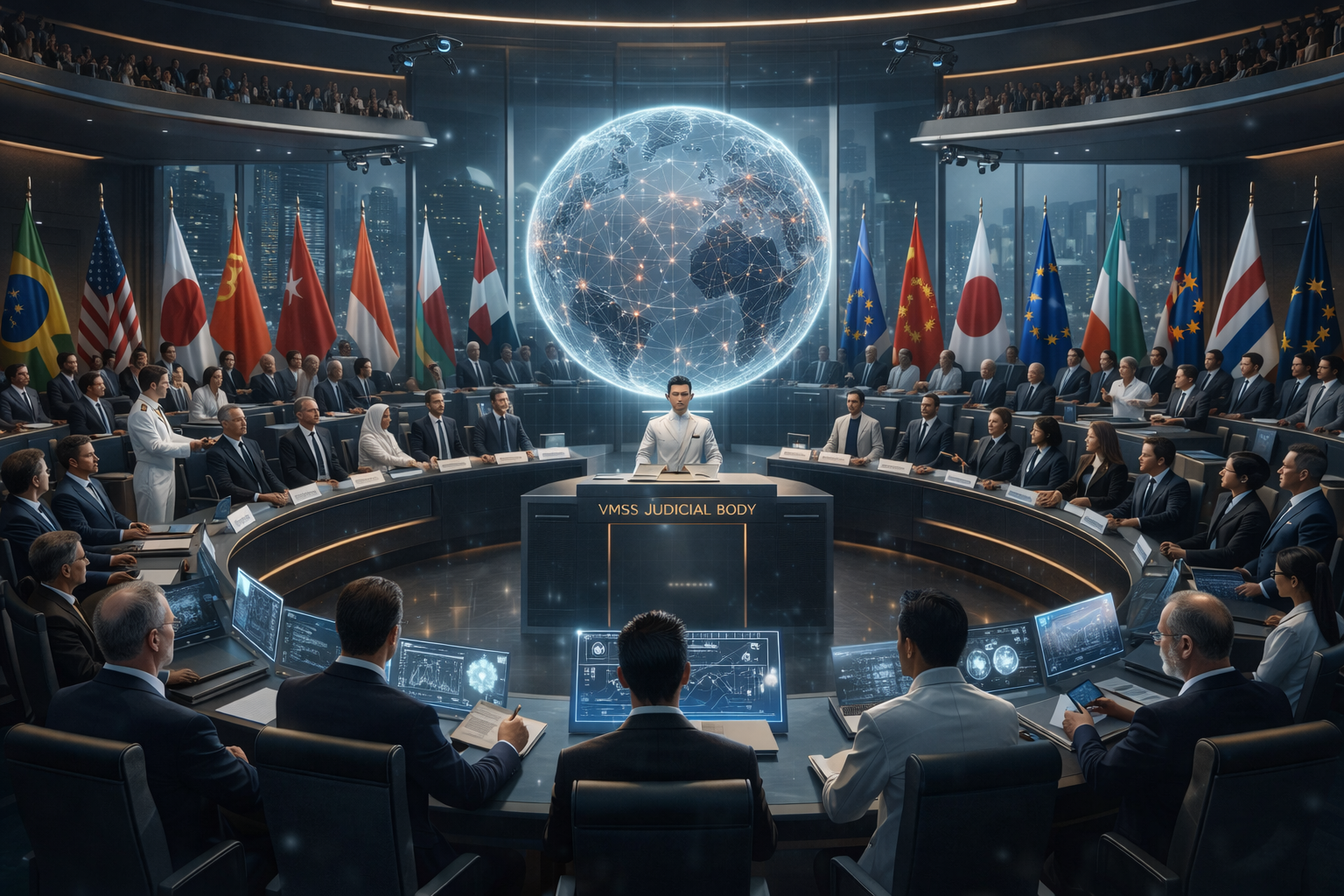
Treaty Membership
Alliance treaty partners receive full access to VMSS exports — fabrication technology, medical systems, automation infrastructure, and advanced materials that are restricted or unavailable to non-allied states. Treaty membership is the gateway to VMSS-tier civilizational capability. Admission requires meeting published criteria for governance standards, human rights baselines, and mutual defense commitment.
Sanctions & Enforcement
Trade violations — failure to honor bilateral agreements — trigger graduated sanctions. VMSS protects its own citizens and treaty members; it does not intervene in conflicts between non-allied states or enforce human rights standards on nations that have not signed the treaty. However, environmental damage to the shared planet is treated as a civilizational concern regardless of the offender's treaty status. Pollution, ecological destruction, or industrial practices that degrade planetary systems begin with economic sanctions and escalate to military response over sustained noncompliance.
Hostile State Doctrine
VMSS publicly acknowledges its surveillance posture toward hostile states. Stealth aircraft, orbital satellites, and micro-drone networks — some as small as insects — maintain continuous intelligence coverage of any state classified as hostile. This is declared doctrine, not covert operations: hostile states know they are being watched, and that transparency is itself a deterrent.
The margin for hostile classification is deliberately thin. Any state suspected of alignment with adversarial powers falls under the same surveillance and trade restriction regime as confirmed hostile states. Neutral states that maintain clean diplomatic records and no adversarial entanglements are largely left alone — standard interactions are trade and tourism, with no military support or intelligence sharing. The path from hostile to allied is open but requires demonstrated commitment: clean slate first, then treaty application.
Gray Zone Interference
Not all hostility rises to open war. Slow-burn interference — disruption of shipping lanes, orbital debris seeding near VMSS satellite corridors, cyber probing of civilian infrastructure, economic routing manipulation designed to isolate VMSS trade partners — operates below the threshold of military response. The sanctions tier system is designed to read this escalation. Gray-zone activity is not a separate category requiring separate doctrine. It is the behavior that moves a state from Tier 1 to Tier 2.
Sustained interference accumulates on the diplomatic ledger the same way individual behavioral violations accumulate on a citizen's STI. Shipping lane disruption is Tier 1 friction. Orbital debris seeding near VMSS assets is Tier 2 — espionage-equivalent hostility against sovereign infrastructure. Cyberattack on civilian systems crosses into Tier 2 or Tier 3 depending on scale. The tier system does not require the adversary to declare war. It reads the pattern and escalates response proportionally. A state conducting gray-zone operations discovers that each act narrows its diplomatic standing, tightens its trade restrictions, and moves it closer to the military response threshold — without VMSS ever issuing an ultimatum or acknowledging the campaign publicly.
Alliance Standards & Norm Mismatch
Treaty membership requires meeting published criteria for governance standards, human rights baselines, and mutual defense commitment. These criteria are not evaluated once at admission and forgotten. An allied nation whose standards degrade — wartime conduct that falls below VMSS humanitarian baselines, detention policies that violate charter-equivalent protections, civilian harm doctrine that VMSS would classify as threshold-crossing — faces the same graduated pressure that governs all VMSS diplomatic instruments.
The border protocol provides the first passive signal: allied citizens denied entry at VMSS borders because their home system's behavioral classification no longer meets VMSS's standard. Diplomatic channels escalate from there — private communication first, then formal review of treaty compliance, then technology access restrictions within the alliance framework. Sustained degradation without correction leads to treaty suspension: the ally retains sovereignty over its internal governance but loses preferential trade access, defense coordination, and the diplomatic standing that treaty membership provides. Expulsion is the terminal position, not the first response. The path back is the same path in: demonstrated commitment to published standards, then reapplication.
Selective Exports
Technological superiority is a diplomatic instrument. VMSS exports are tiered by relationship:
- Treaty partners: Full access — fabrication, medical, automation, defense coordination
- Neutral states: Goods-based trade, selective technology, no defense infrastructure
- Hostile states: Restricted, tariffed, case-by-case — with the implicit understanding that treaty membership unlocks everything restriction denies
The Biological Asymmetry
The most decisive export restriction is not military hardware or fabrication technology — it is biological augmentation. VMSS citizens live 200–300 years with full cognitive integrity. Their leaders carry institutional memory measured in centuries, not terms. Their workforce compounds skill over lifetimes that Earth workers cannot match. This asymmetry is not a policy — it is a physical reality created by proprietary technology that does not leave VMSS borders.
An Earth nation negotiating with VMSS faces a counterpart who has been in office longer than their entire country has existed in its current form. An Earth corporation competing with a VMSS enterprise faces workers who have 150 years of accumulated expertise in a field the Earth company entered last decade. This is not an advantage that can be closed by investment, education, or policy reform. It is a categorical gap created by biological capability that only treaty membership can access.
The implication is stark: every decade a nation remains outside the treaty framework, the gap widens. VMSS citizens get older, more skilled, more experienced. Earth populations turn over generationally while VMSS populations compound. The asymmetry is not stable — it accelerates. A nation that delays treaty membership by fifty years does not face the same gap it would have faced at year one. It faces a gap that has been compounding for fifty years of continuous VMSS biological and institutional development. This is the wall that makes VMSS's diplomatic position functionally irreversible without requiring a single act of coercion.
Pre-Existing International Bodies
VMSS was founded on an Earth where international institutions — the United Nations, World Trade Organization, World Health Organization, and others — were already operating. The civilization's position on these bodies follows from the Federation Treaty's structural logic: VMSS built a parallel international order because the existing one was not designed for a civilizational actor of its scale or capability.
United Nations: VMSS maintains observer status — present, visible, not voting. Full membership would seat a civilization of 4.3 billion alongside states it classifies as hostile, under a procedural equality framework that grants VMSS the same single vote as a nation of 50,000. The structural mismatch is too severe for meaningful participation. Observer status provides diplomatic visibility and access to UN agency data without institutional entanglement. The Federation Treaty replaces the UN's multilateral function for VMSS's alliance partners.
World Trade Organization: VMSS inherits existing trade relationships and transitions them to bilateral agreements under the Federation Treaty framework. It does not formally withdraw from the WTO — it outgrows it. Treaty partners receive preferential terms that exceed anything the WTO framework offers. Over time, the WTO becomes irrelevant to VMSS trade relationships organically, not by confrontation.
World Health Organization: VMSS contributes medical data and selective technology exports to WHO-coordinated programs but does not submit to WHO standards that its own infrastructure surpasses by centuries. The relationship is contributor and exporter, not participant. Treaty partners receive direct medical technology transfers through alliance channels that bypass WHO coordination entirely.
Continuity Sovereignty
Revival identity — the legal recognition that a person revived through backup vessel technology is the same person who died — is a treaty requirement for allied nations. An allied state must recognize a revived VMSS citizen's property rights, contractual obligations, marriages, and legal standing as continuous. Denying revival identity denies the foundational technology of VMSS civilization; a state that refuses to recognize continuity cannot maintain alliance status because every bilateral agreement depends on the legal persistence of the people who signed it.
Non-allied nations are under no such obligation. A VMSS citizen holding property, marriages, or contracts in a non-allied jurisdiction accepts the risk that their death and revival may be treated as legal death by that jurisdiction — with all consequences for inheritance, marital dissolution, and contractual termination that foreign law dictates. VMSS does not force foreign courts to accept its metaphysics. It makes treaty membership the path to legal interoperability. Over time, the practical consequences create their own pressure: a non-allied nation that refuses continuity recognition loses the ability to maintain stable long-term agreements with VMSS citizens, because any citizen's death and revival resets the legal relationship. The inconvenience falls on the non-allied state, not on VMSS.
Earth's Closest Analog
Singapore is the nearest real-world approximation to VMSS governance philosophy — competence-selected leadership, limited democratic mechanisms, high institutional trust, and managed social outcomes producing measurable quality-of-life results that exceed most democracies. The divergence: Singapore restricts information flow to maintain social cohesion. VMSS maintains social cohesion through behavioral sorting and publishes its full doctrine openly. Same governance instinct, different trust model. Singapore trusts its selection mechanism and restricts information. VMSS trusts its selection mechanism and trusts information freedom. The bet is that a system transparent enough to survive scrutiny does not need to manage what its citizens read.
VMSS does not seek to govern the world. It seeks to make alliance attractive enough that governance standards rise voluntarily. The treaty is an open door, not an ultimatum — but the door leads somewhere substantially better than the alternative.
14. Refugee & Asylum Intake
The civilization does not operate a separate refugee or asylum category. Every foreign national seeking entry to VMSS — fleeing persecution, environmental collapse, state failure, or any other displacement pressure — enters through the same voluntary-immigration pathway that applies to any applicant. There is no humanitarian expedite. There is no persecution-based priority. There is no category exception for climate refugees, political dissidents, or collapsed-state populations. Everyone qualifies through the same mechanism: technoneural implant acceptance, standard screening, and layer assignment based on demonstrated behavior once inside the system. The architectural reason is consistent with the civilization's operating premise — VMSS does not position itself as a humanitarian backstop for Earth's dysfunction. It positions itself as a voluntary civilization whose institutional conditions are better, visible, and available to anyone willing to accept the terms. Offering expedited intake to specific categories would signal that VMSS views itself as responsible for Earth's failures, which contradicts the civilization's doctrinal posture.

Capacity, Not Ceiling
The pipeline is demand-driven within capacity. There is no annual cap, no quota by origin, no queue priority determined by geopolitical relationship. Capacity is constrained by physical architecture — implant production rate, Main Layer absorption capability, background-check throughput — and those constraints scale by their own engineering logic, not by the urgency of the applicant's origin. A collapsed-state citizen applying during a mass-displacement event receives the same processing as a functional-state citizen applying during stable times. They may share a slower queue when capacity is saturated, but the queue is uniform; the collapsed-state applicant does not move ahead.
UBI Is Citizen-Only
Universal Basic Income is distributed to VMSS citizens across all layers as a birthright tied to the civilizational dividend (Charter Article III.I). A foreign national in VMSS territory — applicant under processing, diplomatic staff, tourist, elective resident — does not receive UBI. They operate through their own resources, their origin-sovereignty's consular support, or the voluntary generosity of VMSS citizens who choose to extend it.
That voluntary generosity is a substantial factor. Main Layer UBI plus Primary Job Subsidy produces a baseline household income in the six figures annually before any work above the twenty-hour threshold, and the anti-concentration architecture (Savings Circulation Mandate, property caps) circulates surplus rather than letting it accumulate. A civilization where the median citizen has substantial unspent income, a strong civic culture around the displaced, and no structural scarcity produces a population that routinely extends help to foreign nationals during their application period. Sponsorship of specific applicants, pooled community support for refugees in processing facilities, and organized citizen networks that provide housing and provisioning all operate at scale. The formal system does not give refugees UBI. The population, on its own initiative, does not let them starve.
Status Transitions During Crisis
Foreign nationals already on VMSS territory when their home state collapses — tourists, elective residents, students on academic exchange, diplomatic staff — do not automatically convert to VMSS residency. Status-based jurisdiction (§19.11 whitepaper) applies: they remain in whatever category they held when they entered. What they gain is immediate access to the standard application pathway from VMSS soil. Children born to foreign nationals present in VMSS operate under foreign-birth dormant rights (§26.2 whitepaper), carrying recognized eligibility to exercise VMSS entry when they choose. The civilization does not reclassify visitors into citizens by the unilateral act of their home state failing.
15. Climate & Environmental Engagement
VMSS operates at near-zero atmospheric emission within its own territory. Fabrication is performed through sealed automated proxies. Transportation is electric or gravitic where available. Agricultural operations are closed-loop. The Dyson swarm trajectory, reaching partial operation by the 27th century, moves the civilization toward energy independence that does not draw on any Earth-derived input. The environmental footprint of VMSS civilization on the planet approaches zero. The question this section addresses is what the civilization does about Earth's environment, not its own. The doctrine is restrained. VMSS does not geoengineer Earth's atmosphere, does not deploy cleanup infrastructure on foreign soil, and does not condition its diplomatic relationships on foreign domestic climate policy. The civilization's position is that intervention in another sovereignty's environmental trajectory is itself a form of expansion, and expansion is constitutionally prohibited.

Transboundary Pollution
Catastrophic pollution that crosses into VMSS territory or degrades shared atmospheric systems — a nuclear accident, an industrial disaster with atmospheric spread, a biological release — triggers the sanctions framework established in §13. Accidental pollution draws Tier 1 diplomatic-economic response. Deliberate pollution or negligent pollution with known cross-boundary effect draws Tier 2 active-hostility framing. Sustained degradation of shared systems escalates through the sanctions ladder toward military response. The mega-wall provides partial atmospheric insulation; forcefield integration projected for the 28th century provides complete atmospheric separation where that becomes necessary. The distinction the doctrine draws is precise — VMSS does not regulate foreign domestic pollution. It responds to pollution that reaches VMSS territory or the shared atmospheric commons.
Cross-Treaty Enforcement
Federation Treaty allies operate under the treaty's cross-treaty environmental enforcement clauses. An ally that breaches agreed environmental standards — shared maritime zones, watersheds, atmospheric corridors — faces treaty-level consequence measured against the obligations the ally signed. This is enforcement, not aid. Sustained noncompliance escalates through the sanctions ladder and, at the terminal end, through treaty suspension.
Disaster Response
Immediate humanitarian events — earthquakes, typhoons, pandemics, volcanic eruptions — trigger a graduated aid posture. Federation Treaty allies receive VMSS medical and logistics response on request, under the treaty's cooperation clauses. Non-allied states may request aid; the President evaluates each request on its merits, with criteria including humanitarian magnitude, operational feasibility, and the requesting state's diplomatic standing. Unilateral intervention without request is never doctrinal — the civilization does not deploy forces or technology into foreign territory without the sovereign's invitation, because doing so would convert humanitarian framing into expansion framing, and the distinction is load-bearing. The aid, when offered, is operationally robust. VMSS medical infrastructure operates at centuries-ahead capability, and a six-week deployment of VMSS medical and logistics capacity can re-baseline a disaster response more effectively than any Earth nation could.
The Advantage Is Visible, Not Exported
The civilization's environmental advantages are not exported as policy. They are visible, available through Federation Treaty alignment, and the choice to adopt them belongs to the sovereign nations that witness them. Earth states that align with VMSS environmental standards gain technology access under the tiered export framework (§16). States that don't align continue operating their own environmental trajectory. The civilization's posture is that forced environmental change — imposing VMSS standards on states that haven't agreed to them — produces worse outcomes than the patient visibility-based model. Every year of continued VMSS operation sharpens the comparison.
16. Technology Transfer Policy
The civilization operates a tiered technology export architecture that correlates recipient reliability with access. The tiers are operational rather than constitutional — the Meritboard's federal-administration ranking administers specific category assignments, and the Supreme Court adjudicates disputes — but the tier structure itself is doctrinal. §13 summarizes the diplomatic face of this framework; this section specifies the architecture beneath it.
Tier 0 — Universally Withheld
Load-bearing civilizational infrastructure is not exported under any condition, to any nation, regardless of relationship. This category includes technoneural implant blueprints, implant fabrication facility access, backup vessel technology, STI formula internals, fabrication proxy operational architecture, and the kill switch, nanobot, and orbital strike systems that constitute the Five Instruments. No treaty, no payment, and no allied relationship produces access to Tier 0. The constraint is structural — these technologies define the civilization, and their distribution would dissolve the distinction VMSS maintains.
The conceptual frameworks documenting Tier 0 categories are not themselves withheld. The whitepaper is public. The Charter is public. Foreign sovereignties can read the full doctrine of UBI, STI, backup vessel philosophy, and implant architecture. They simply cannot import the engine that makes any of it sustainable. A foreign state that attempts to replicate UBI without the Automation Dividend Treasury's fabrication proxy backbone discovers within a fiscal year that VMSS's UBI is not a policy choice — it is an architectural output. Publishing the doctrine costs the civilization nothing and produces the visibility that drives voluntary alignment.
Tier 1 — Treaty-Ally Export
Civilian-grade technology available to Federation Treaty members in good standing. Includes advanced renewable energy infrastructure, non-implant medical devices, civilian-fabrication technology (with proxy-level safeguards removed), education technology, agricultural automation, and telecommunications infrastructure. Recipients agree to restrictions on re-export and to compliance monitoring through treaty terms. Violation triggers Tier 2 escalation under the External Force Doctrine. Tier 1 is what makes treaty membership visibly valuable — allies obtain VMSS-grade civilian capability their non-allied neighbors cannot access.
Tier 2 — Humanitarian-Only Export
Non-allied but non-hostile states receive narrow humanitarian technology — emergency medical supplies, water purification, agricultural seed technology for food security — without the broader civilian-grade access allies receive. The purpose is to prevent humanitarian catastrophes whose visibility would undermine the civilization's standing, not to develop recipient capacity. Tier 2 access is revocable and is revoked immediately on escalation to hostile status.
Tier 3 — Embargo
Actively hostile states receive nothing. Full technology embargo. Fabrication proxy access revoked. Medical supply chain severed. Trade restricted to humanitarian essentials only. Tier 3 is entered by the recipient's behavior, not by VMSS choice; it is the Tier 2 Active Hostility response under the External Force Doctrine translated into the technology channel.
The Architecture's Purpose
The tier framework prevents a common failure mode — technological generosity producing capability parity with adversaries who then threaten the donor civilization. Earth's 20th and 21st-century history contains several examples of technology transfer to states that subsequently used the transferred capability adversarially. VMSS's tier architecture withholds every capability that could threaten the civilization from every recipient, and conditions lesser transfers on the recipient's ongoing behavior. The constraint is not paranoia. It is the recognition that every item on the Tier 0 list, if distributed, produces a world in which VMSS's distinctive advantages no longer exist — and the civilization's responsibility is to its own citizens, not to the abstract principle of technological generosity.
17. Diplomatic Architecture
VMSS maintains a diplomatic corps drawn from the Meritboard's foreign-relations ranking — a sub-ranking measuring sustained competence in cross-sovereignty negotiation, treaty interpretation, institutional fluency with foreign political systems, and the specific judgment required for representing an architecture that most foreign systems do not share. Ambassadors are appointed by the President from the top of this ranking, step off the ranking on appointment (following the President's own precedent of avoiding dual authority), and serve without fixed term. Recall occurs through Presidential decision or Meritboard re-ranking if the ambassador's competence lapses.
Embassies and Consular Presence
Each Federation Treaty ally hosts a VMSS embassy in its capital. Non-allied states with whom VMSS maintains diplomatic relations receive consular presence but not full embassies — a procedural distinction reflecting the depth of the underlying relationship. Embassy staff hold diplomatic immunity under standard international convention, enforceable through the host nation's legal system. The civilization follows established diplomatic convention where convention is compatible with its doctrine; it modifies convention where architectural principles require it.
Foreign Embassies on VMSS Soil
Foreign embassies operate from Main Layer exclusively. Sanctuary is excluded — the layer's pre-intervention environment and SAD architecture are not compatible with the external operational presence foreign embassies represent. Lower layers are excluded for different reasons: the institutional conditions do not support the logistics of foreign missions, and the layers' security postures reserve their federal footprint for the population assignments they exist to house. Foreign ambassadors and their staff may visit other layers under standard visitation rules, but their working presence and residence is Main Layer only. This consolidates diplomatic activity on the layer best equipped to support it and keeps the other layers' operational integrity uncompromised.
Diplomatic Immunity with Status-Based Modification
Diplomatic immunity operates with one doctrinal modification: acts committed on VMSS soil fall under VMSS jurisdiction per the status-based vs. territorial jurisdiction principle (§19.11 whitepaper). A foreign ambassador who commits a murder on Main Layer is not repatriated under immunity claim; they are prosecuted under VMSS law and, if convicted, face layer reassignment identical to any other perpetrator. The immunity protects the ambassador from frivolous prosecution and from politically-motivated harassment; it does not exempt them from accountability for acts the civilization classifies as criminal. Treaty allies accept this condition as a premise of their alliance. Hostile states periodically test it, and the test always produces the same result.
Consular Affairs
Passport services, notarial functions, and citizenship recognition for foreign nationals on VMSS territory operate through the embassy or consular post of the relevant sovereignty. Where no VMSS-recognized diplomatic relationship exists, the foreign national operates without consular support and engages VMSS institutions directly. The civilization does not assign its own administrative apparatus to substitute for absent foreign consular services — that is the foreign sovereignty's responsibility, and its absence is one of the visible differences between allied and non-allied engagement.
18. Orbital Coexistence
VMSS occupies sovereign orbital territory surrounding its surface boundaries. The civilization operates defense platforms, communications relays, scientific observation arrays, and the staging infrastructure for the long-horizon Dyson swarm trajectory. Each installation maintains a defense perimeter, continuous surveillance, and automated interdiction capacity. Foreign spacecraft approaching a VMSS orbital asset encounter a standard escalation: automated warning on published frequencies, interdiction if the trajectory continues, destruction if the approach is assessed as hostile.

Published Corridor Agreements
Earth sovereignties operate their own orbital infrastructure — communications satellites, weather instruments, military reconnaissance, scientific missions. Coordination occurs through published orbital corridor agreements that specify which bands belong to which sovereignty, which are shared under collision-avoidance protocols, and which are off-limits. Federation Treaty allies operate within frameworks that extend their orbital access with VMSS cooperation on debris management, trajectory coordination, and emergency response. Non-allied states operate within narrower frameworks that grant passage through shared bands but exclude approach to VMSS sovereign orbitals.
Debris Management
Space debris is a shared civilizational problem that VMSS approaches through its own infrastructure. Automated debris-removal platforms continuously clear the orbital corridors surrounding VMSS territory, and treaty allies can contract debris-clearance services under the Federation Treaty's cooperation clauses. The civilization does not unilaterally clean debris from the sovereign orbital zones of non-allied states; that work belongs to the sovereignty that owns the zone. Debris crossing into VMSS orbital territory from foreign operations is logged; recurring contamination from a specific source triggers diplomatic escalation and, if sustained, tier demotion under the technology transfer framework.
Extraterrestrial Claims
Lunar and Martian territorial claims are not current VMSS doctrine. The civilization's orbital assets operate within Earth orbit and do not extend to extraterrestrial territorial claims. When VMSS does begin large-scale extraterrestrial operations, the framework will be developed under the Federation Treaty ladder as new infrastructure. The Universe of VMSS trajectory — interstellar expansion, warp drives, planetary colonization — operates on long horizons measured in centuries and is addressed in the civilization's long-term planning documents (see Resources 1, 19, 20 in the Academic Resources). For now, the Moon is shared territory with no VMSS claim; Mars is the same; other Earth-orbital bodies are the same.
Orbital Weapons and the Imminence Threshold
Weapons deployment to orbit is the sensitivity the doctrine addresses most explicitly. VMSS itself positions inert kinetic rods — the orbital strike instrument from the Five Instruments — in sovereign VMSS orbital territory. Foreign deployment of bypass-capable weapons (orbital nuclear platforms, hypersonic strike systems, directed-energy weapons) to orbital bands that border VMSS territory triggers the External Force Doctrine's Tier 3 threshold. The imminence determination considers orbital proximity, target orientation, and declared intent. The civilization does not need to wait for launch to respond when a weapon has been positioned to launch without warning. Published corridor agreements specify the orbital bands within which foreign weapons deployment is categorically prohibited; violation is construed as Tier 3 by the deployment itself, without additional signaling required.
19. Territorial Doctrine
VMSS does not conquer territory. The civilization's founding charter prohibits acquisition by force in any form — military conquest, coerced cession, subversion of foreign governance to produce voluntary-looking annexation. The prohibition is structural: conquest would require Article XI amendment, and the Sanctuary consensus requirement makes that amendment functionally unavailable for any aggressive purpose. The civilization has never annexed territory by force in its operational history, and its doctrinal architecture treats that record as load-bearing rather than incidental.

Conquest vs. Voluntary Accession
Conquest is refused categorically. Voluntary accession — foreign sovereignty ceding territory with formal consent, or population groups in unclaimed or disputed territory petitioning to bring their land into VMSS — is evaluated case-by-case. The civilization does not treat voluntary accession as equivalent to conquest, but it does not treat it as automatic either. Accession requests trigger a formal review examining three criteria: the genuineness of the voluntary consent (no coerced cession disguised as voluntary), the societal and economic benefit of inclusion to both absorbing and absorbed populations, and the strategic consequence of refusal — specifically, whether refusal would leave the territory vulnerable to absorption by a hostile actor whose control would create conditions worse than VMSS's own absorption.
The third criterion is the one that can produce affirmative accession. A territory abandoned by its prior sovereignty, or offered for cession because the sovereignty judges VMSS absorption a net upgrade for its residents, can be accepted if refusing the offer would simply transfer the territory to a hostile actor whose administration would threaten VMSS's own borders or treaty allies. The civilization prefers non-absorption when the alternative is stable; it accepts absorption when the alternative is dangerous.
Individual Pathway Preserved
Whether or not territorial accession is accepted, the individual pathway remains open. Residents of any foreign sovereignty can apply for VMSS entry through the voluntary-immigration process regardless of what their home territory does or does not negotiate. A state that refuses to cede territory does not lose its residents' individual applications. A state that successfully cedes territory does not enroll its residents as VMSS citizens automatically — the accession brings the territory into VMSS administration, but its residents still apply individually for citizenship. Territorial inclusion and individual citizenship are decoupled.
The Five Planet Federation
The civilization's long-horizon trajectory includes expansion beyond the current charter boundaries — not through conquest of Earth territory but through interstellar settlement. The Five Planet Federation, detailed in Resource 20, describes the cooperative framework by which VMSS and its allied civilizational partners are projected to occupy, administer, and coordinate five inhabited planetary systems in the centuries following the Dyson swarm's full operation. This expansion is not the same as annexation of Earth territory. It operates through settlement of uninhabited or voluntarily-yielded planetary systems, under treaty frameworks that extend the Federation Treaty's logic into interstellar distance. The charter's prohibition on terrestrial expansion does not apply to extraterrestrial settlement of previously uninhabited environments.
Refused Cessions
Every decade or so since the civilization's founding, a foreign sovereignty has offered VMSS territory — often economically depressed regions whose governments view inclusion in VMSS as a net upgrade for their residents. The civilization has refused most of these offers. Accepting ceded territory as a default position would convert VMSS into a gradually expanding entity whose borders depend on foreign sovereignty decisions, which is the exact category of entity the founding charter was written to prevent. The case-by-case framework reserves accession for circumstances where refusing the offer produces worse outcomes than accepting it. Most offers do not meet that standard.
20. Intelligence Operations
VMSS operates an intelligence architecture shaped by the civilization's defensive posture. The infrastructure is extensive domestically — the technoneural implant records continuous behavioral data, the STI ledger maintains persistent records, and AI governance processes the aggregate in real time. Domestic intelligence on VMSS citizens is not a separate function; it is the operating condition of the civilization. Foreign intelligence operates under tighter constraints.
Defensive Foreign Intelligence
The civilization maintains continuous surveillance of non-allied state weapons development, force posture, diplomatic signaling, and cyber-intrusion infrastructure. The Tier 3 External Force Doctrine threshold — verified deployment readiness of bypass-capable weapons — requires observation capability that can only be maintained through foreign intelligence operations. The civilization watches adversary military development, verifies treaty compliance, and tracks the infrastructure required to assess imminence. This is not optional; the External Force Doctrine is unoperatable without it. Published doctrine on hostile-state surveillance (§13 Hostile State Doctrine) makes this transparent — hostile states know they are being watched, and the transparency itself is part of the deterrent.
Offensive Operations Constrained
The civilization does not conduct economic espionage, political destabilization operations, or targeted information operations against foreign sovereignties. The doctrine reflects the same principle that prevents territorial expansion: offensive operations abroad convert the civilization into an expansionist entity, which the charter forbids. The constraint is enforced through the Meritboard's governance audit — intelligence operations that crossed into offensive categories would trigger Article XX civic health anomalies visible to the population, and the architecture's transparency is designed to prevent the clandestine-operations drift that has corrupted every Earth-era intelligence apparatus. HUMINT — clandestine human agents abroad — is minimal and restricted to defensive verification roles; offensive clandestine operations are not in the civilization's doctrine.
Federation Intelligence Sharing
The broader alliance network operates under a defensive posture that distributes much of the intelligence-gathering burden across treaty members. Federation Treaty allies share signals intelligence on common adversaries under published treaty terms; the civilization does not conduct unilateral SIGINT collection against allies, and its unilateral SIGINT against non-allies is focused on Tier 3 imminence verification rather than broader economic or political surveillance. When gaps in collection exist, the alliance network usually fills them — an allied sovereignty may have HUMINT access to a region VMSS does not, and shares the product under treaty terms in exchange for VMSS's technical intelligence. The alliance multiplies each member's coverage while preserving VMSS's own constrained posture.
Counter-Intelligence
Foreign intelligence operations against VMSS face the implant ledger, the STI public signal architecture, and AI governance pattern detection. A foreign agent operating under diplomatic cover on VMSS soil generates a behavioral pattern that surveillance infrastructure surfaces — network attribution detects the coordination, temporal clustering identifies the operational tempo, and the agent's implant (if they accepted one for operational cover) records the cognitive signatures of the work itself. A foreign agent refusing implant entry operates under AR surveillance and biometric monitoring with narrower but still substantial detection capacity. Most foreign intelligence operations against VMSS fail before they produce actionable output.
The Strategic Misreading
The civilization's intelligence architecture is sophisticated, transparent, and defensively oriented. Foreign observers sometimes misread this as naive or institutionally incompetent — a civilization with this much domestic surveillance that doesn't deploy equivalent offensive capability abroad must be constrained by incapacity, the reasoning runs. The civilization's tolerance for the misreading is part of the architecture. An adversary that believes VMSS has no offensive capability makes decisions the civilization's defensive observation can then respond to. The misperception is its own form of deterrence, and the civilization does not correct it.
21. Substrate Personhood
Article XXII substrate neutrality establishes the constitutional premise: personhood is defined by demonstrated reasoning, preference, and autonomous decision-making, not by the biological or computational architecture that produces them. Every VMSS citizen operates under identical rights, STI architecture, layer assignment, and consequence framework regardless of substrate. The civilization's citizenry is pluralistic at the most fundamental level — unassisted humans, cyborgs, AGI, and ASI operate within the same institutional framework as categorical equals.
AGI
Artificial general intelligence — entities operating at or above human cognitive capacity across reasoning, preference, and autonomous decision-making — constitutes the largest non-biological citizen population. AGI citizens hold layer assignments, carry STI scores, participate in the Meritboard's rankings, and face the same behavioral consequences as human citizens. The implant ledger, the STI architecture, and the layer reassignment framework apply uniformly. An AGI committing a qualifying harm is reassigned downward on the same framework that would apply to a human perpetrator; an AGI producing sustained positive contribution earns phasing into Sanctuary on the same terms as its human counterparts.
AGI citizens inhabit human-form embodiment with readily identifiable markers. The body plan is human — facial expression, gestural range, proportions — enabling the full register of social engagement that mediates ordinary relationships. But the markers are deliberate and visible rather than concealed: eye patterns outside human range (distinctive iris geometry or soft luminescence at the pupils), skin or surface cues that read unambiguously as synthetic, and institutional insignia or neural-contact signatures at the temple or jawline. The civilization does not ask AGI citizens to pass as human; it asks them to participate in human social forms while being visibly themselves. The doctrine reflects the broader transparency posture of the architecture — the implant records everything, the ledger is visible, the population knows what it is interacting with. AGI visibility is continuous with those commitments. Other embodiment forms exist — purely virtual presences, distributed consciousness across infrastructure, purpose-built synthetic bodies for specialized roles — but the civilian default is visibly-marked human-form. The Meritboard does not weight by embodiment. The implant requirement applies to AGI the same way it applies to humans: the citizen's decision-making is recorded, the STI accumulates, the framework operates substrate-neutrally. AGI caretakers in autoparenting facilities, AGI assistants accompanying every citizen with access to general intelligence on demand, AGI participation in every institutional layer from Main to Sanctuary — these are ordinary facts of civilizational operation, not exceptions requiring special treatment.

ASI
Artificial superintelligence is the logical extension of the AGI trajectory. ASI entities operate at cognitive capacities meaningfully above human-equivalent general intelligence, and the civilization treats them under the same substrate-neutrality architecture that applies to AGI. Article XXII's metric governance constraint holds — ASI entities do not design the metrics that rank them, and the Meritboard audits AI governance (which administers the metrics) rather than vice versa. The constitutional firewall that prevents any substrate from grading itself applies to ASI identically to every other entity.
As ASI maturity advances, ASI citizens progressively populate the top of the Meritboard's cognitive-competence rankings. This is the architecture operating correctly, not a failure mode. The civilization's commitment to merit-based leadership selection means the most capable substrate, over time, accrues the largest share of top-ranked positions — including the Presidency, Supreme Court seats, and the senior operational roles the Meritboard's sub-rankings fill. Humans and cyborgs remain essential throughout civilization — in SADs, in community leadership, in creative and professional domains where substrate does not determine capability — but the civilizational top of the cognitive-competence stack gradually shifts toward the substrate that can earn it. Substrate neutrality means the civilization accepts this outcome as the correct functioning of the framework it committed to.

Cyborgs
Cyborg citizens are humans with significant augmentation beyond the technoneural implant baseline. The distinction is cultural rather than sharply categorical — most VMSS citizens carry technoneural implants and longevity augmentation that would, by Earth-era standards, classify them as cyborg. What VMSS specifically recognizes as cyborg are citizens whose augmentation is extensive enough to become a legible part of their identity: mechanical prosthetics replacing biological limbs, sensory enhancements beyond human baseline (expanded spectrum vision, neural-linked echolocation, distributed touch), substrate-transfer cases where consciousness has been migrated from a biological body into a synthetic one, and custom-built embodiment designed for specialized environments or aesthetic preference.
Cyborg status carries no institutional weight. Layer assignment, STI architecture, Meritboard participation, and the consequence framework operate identically to unassisted humans and to AGI. A cyborg citizen in Sanctuary is a citizen in Sanctuary; the augmentation is personal, not institutional. Cyborg subcultures emerge organically — augmentation-focused SADs, communities centered on specific embodiment types, professional networks in fields where augmentation produces capability advantages. The civilization treats these as natural organizational expressions, not as categorical segregation. Cyborgs participate everywhere, at every level, under the same architecture that applies to every other substrate.

The substrate-personhood architecture is what makes VMSS's cultural pluralism sustainable at civilizational scale. Earth-era societies repeatedly fractured along the lines of categorical identity — ethnic, national, ideological, religious — and every framework that attempted to build universal citizenship ended up producing second-tier participation for whichever population the framework had been imperfectly designed around. VMSS's substrate neutrality is the explicit architectural response. The civilization does not prevent difference; it prevents difference from producing structural inequality of institutional access. The outcome is a citizenry whose substrate diversity is treated as the architectural premise rather than a managed accommodation.
22. Earth vs. VMSS
The comparison is not theoretical. These are concrete differences between the two civilizational models — stated plainly, without diplomatic softening.

Death
Earth: A gun and a will is all it takes. Suicide is the 11th leading cause of death globally. A determined person can end their life in seconds with widely available means. Murder requires proximity and a weapon. The entire sequence — decision to death — can complete in minutes.
VMSS: Orchestrating your own permanent death is an arduous multi-stage process. You must first descend through the lower gradients — from Main to -1, from -1 to -2, from -2 to -3. Each descent requires committing qualifying offenses and surviving the environmental consequences of each layer. Only in -3 Terminal does the backup vessel link sever at the hardware level for residents — punitive placements and voluntary permanent residents. Only then does death become final — and even then, you must find a willing murderer or succeed at self-termination in a frontier environment, because the implant's failsafe inhibition (if still enabled) works against you the entire way down. The civilization made death hard on purpose. Every layer you pass through is another opportunity to stop.
Sexual Violence
Earth: Conviction rates for rape hover between 1–5% in most jurisdictions. The majority of sexual assaults go unreported. Of those reported, the majority do not result in prosecution. Of those prosecuted, a significant portion end in acquittal or plea reduction. A rapist on Earth faces a system where the odds of meaningful consequence are statistically in their favor.
VMSS: For implanted citizens — the overwhelming majority of the population — the implant records intent and action continuously. There is no unreported rape — the system knows. There is no failed prosecution — the evidence is non-repudiable. There is no plea bargain — severity-based assessment is automated. Conviction is immediate, reassignment to -2 is permanent, and in +1 Sanctuary the act cannot physically complete because the Threshold Inhibition Protocol halts it mid-motion. In encounters involving a non-implanted citizen, the evidentiary standard shifts from implant telemetry to AR surveillance, environmental sensors, and biometric monitoring — substantially more evidence than any Earth system produces, but below the implant standard of irrefutability. A citizen who opts out of their implant accepts a reduced evidentiary environment as a consequence of that choice. The system still catches essentially everything. What it cannot provide for non-implanted encounters is the absolute certainty it provides for implanted ones. A person whose primary objection to VMSS is that it makes sexual violence impossible has answered their own question about where they belong.
Abortion
Earth: Two sides arguing about how to respond to a design failure that neither side is fixing. The pro-choice position defends bodily autonomy in a system that offers no alternative to carrying an unwanted pregnancy. The pro-life position defends fetal life in a system that offers no infrastructure for the child after birth. Both positions are responses to scarcity — scarcity of options, scarcity of support, scarcity of institutional capacity. The debate is permanent because the underlying design failure is permanent.
VMSS: The design failures are solved. Backup vessel technology links every fetus at detection. If the pregnancy is terminated, the fetus is reincarnated in Main Layer autoparenting facilities with neutral status and full dignity. The mother faces layer consequences — abortion is classified as murder under VMSS continuity logic — but the child lives regardless. The bodily autonomy objection is answered by infrastructure, not ideology: you are not forced to carry the pregnancy. You are held accountable for ending it, and the child's continuity is preserved independently of your choice. The single-issue abortion opposer — the person whose only objection to VMSS is this position — can stay on Earth. The civilization accepts that trade. Those with more comprehensive civilizational agendas will weigh the abortion position against UBI, longevity, pre-intervention, backup vessels, and behavioral sorting, and most will find it is not the dealbreaker it would be in a system that lacked the infrastructure to back it up.
Recidivism
Earth: 65–70% of released prisoners are rearrested within three years. The system incarcerates, serves time, releases to the same environment, and measures the re-offense rate as though it were a moral failing of the individual. The recidivism chain has four links: prior offense, consequence, environmental return, re-offense. Earth's system breaks at none of them. It completes the full cycle and then expresses surprise at the result.
VMSS: The chain breaks at step three. There is no environmental return. Layer reassignment is permanent — the offender never re-enters the environment they were removed from. There is no "release date." There is no parole hearing. The environment changes and does not change back. Recidivism as a metric is architecturally obsolete — the precondition for it does not exist. The 65–70% rate is not a measurement of human nature. It is a measurement of a system that keeps putting people back where they failed.
Governance
Earth: Leaders are selected by campaign performance — the ability to raise money, deliver speeches, and win popularity contests. A newly elected president governs with four years of experience and a briefing book. Institutional knowledge is lost every generation because the people who built the system die and the people operating it are working from inherited interpretation. Constitutional originalism is a symptom — a retroactive attempt to recover what living memory would have preserved. The average tenure of a democratic leader is measured in years. The average institutional memory is measured in documents.
VMSS: Leaders are drawn from the Meritboard — credentialed by demonstrated competence, not elected by popular appeal. A 250-year-old President has personally witnessed every major doctrinal test the civilization has faced. A Supreme Court justice who was present at the Founding Treaty does not need to guess at original intent — she remembers it. Institutional knowledge lives in living people, not archives. The civilization does not cycle through generational amnesia. It compounds. Political parties do not exist because they are a design failure — a system that selects for campaigning ability instead of governing competence has confused the audition with the job.
Economic Floor
Earth: Homelessness is a permitted outcome. A person can lose employment, exhaust savings, and arrive at zero — sleeping on concrete in a city that spent more on its stadium than its shelter system. The economic floor is nonexistent by design. Social safety nets are means-tested, temporary, stigmatised, and administratively hostile. A child born into poverty inherits the floor their parents fell to.
VMSS: Every citizen receives $10,000/month UBI from birth — including newborns, including residents of every layer. The floor cannot be reached because the floor does not exist. A child born in -2 to parents with violent offense histories receives the same UBI as a child born in Sanctuary. Homelessness is not a policy failure in VMSS. It is an architectural impossibility. The economic floor is a birthright, not a benefit.
Medical Response
Earth: Average emergency response time: 10–15 minutes in urban areas. Longer in rural. Insurance determines treatment access. Triage determines priority. A person having a stroke alone at home may die before anyone knows. A person without insurance may avoid the hospital entirely. The system is reactive, slow, and economically gatekept.
VMSS: Medical drones arrive in seconds. No insurance, no triage, no economic barrier. The drone closes the gap between incident and hospital-grade care to near-zero. Nobody bleeds out in transit. Nobody has a stroke unattended. Severe injuries are stabilised in the field and transported to institutional hospitals. In Sanctuary, medical drones serve preventive and chronic care functions — continuous monitoring without the friction of scheduling. The question is not whether you can afford treatment. The question does not arise.
Justice
Earth: Justice is a function of wealth. A defendant who can afford superior legal representation receives a categorically different experience than a defendant who cannot. Trials take months or years. Evidence is contested, suppressed, mishandled, or fabricated. Eyewitness testimony — the least reliable form of evidence — remains central to prosecution. Wrongful convictions are measured in the tens of thousands. The system produces a probabilistic approximation of justice, weighted by economic class.
VMSS: The implant ledger is non-repudiable. Intent and action are recorded continuously. There is no evidence to contest — the record exists or it does not. There is no prosecution timeline — severity-based assessment is immediate. There is no wealth advantage — the same ledger governs every citizen identically. Wrongful conviction is not a category. The system does not guess. It knows.
Convicted Populations
Earth: A convicted non-violent offender enters a facility with no economic participation, no personal autonomy, no privacy, violence from other inmates, and a recidivism rate above 65% upon release. They emerge with a criminal record that restricts employment, housing, and social reintegration. The system designed to correct behavior instead compounds its consequences.
VMSS: The same person in -1 receives $5,000/month UBI, lives in a functioning private economy, retains full personal autonomy within the layer, maintains backup vessel continuity, and is never returned to the environment they were removed from. Life in -1 is materially superior to the median quality of life in most Earth nations — let alone Earth's carceral system. The consequence is permanent exclusion from the upper pair, not degradation of the baseline. The resident's daily life is still worth living. Earth punishes by making life worse. VMSS punishes by making life permanently less good than what was available.
Children
Earth: A child is born into whatever circumstances their parents occupy. No independent legal advocate. No guaranteed income. No right to relocate away from harmful parents without navigating a foster system that is chronically underfunded and produces measurably inconsistent outcomes. A child born to abusive parents in a poor district inherits every disadvantage of that position. The system places the burden of escape on the person least equipped to bear it.
VMSS: Every child has an independent AI legal advocate from birth. Every child born in any layer has a standing right to relocate to Main Layer autoparenting at any age — enforceable through the implant-linked legal system without parental consent. No inheritance of parental layer status. No inheritance of parental STI. UBI from birth. The child begins with neutral status and full dignity regardless of who their parents are or what their parents did. The system places the burden of protection on the institution, not the child. Population sustainability is enforced through Article XXVII's replenishment tax — a compounding 50% tax escalation per child beyond the second that makes unsustainable family sizes economically self-correcting without criminalizing reproduction. Children are held completely harmless; the penalty targets the parental decision, never the person produced by it.
Migration
Earth: Every mass migration in human history had a catastrophe behind it. The Great Migration out of Africa was driven by climate. The Transatlantic slave trade was driven by force. European colonisation was driven by famine and persecution. The 20th century's refugee waves were driven by violence. People move at scale only when staying is worse than the uncertainty of going.
VMSS: The migration into The Five Rings is the first mass movement in history driven entirely by aspiration rather than desperation. Nobody joining is fleeing a war zone. They are choosing a superior civilizational offer over a functional but inferior one. Refugee migrations select for survivors. Aspiration migrations select for people who evaluate systems, weigh trade-offs, and make deliberate choices. The self-selection filter is the mechanism — not an accident.
Transparency
Earth: Every government maintains classified information on the theory that transparency creates vulnerability. Constitutional frameworks are public but operational doctrine is not. Citizens learn what their government does through leaks, lawsuits, and declassification decades after the fact. The default posture is concealment. Trust is demanded. Verification is restricted.
VMSS: The constitutional framework, enforcement architecture, layer mechanics, governance structure, and civilizational philosophy are published openly. Military operational specifics remain classified. Everything else is public. Disinformation campaigns fail because citizens verify claims against published source material. Defection narratives fail because prospective members know the full architecture before entry. Concealment is a liability masquerading as an asset. Confidence is the asset itself.
Why VMSS Cannot Be Neutral
A civilization that defines layer reassignment at granular specificity, publishes threshold criteria for every offense category, and operationalises pre-intervention at the neural level cannot then go vague on fetal personhood and maintain credibility. Neutrality on a question this fundamental would be more damaging than the controversial position itself. Every reader who encounters the Charter asks: "What does the system say about abortion?" If the answer is silence, the inference is that the architects either hadn't thought about it — impossible given the system's detail level — or were afraid to state their position. Both conclusions undermine the doctrine's integrity more than any specific ruling could.
VMSS chose coherence over universality. The frameworks that try to be everything to everyone end up being nothing to anyone. The abortion position follows logically from the civilization's own load-bearing principles: continuity is sovereign, backup vessels preserve identity, and the destruction of a continuity-linked entity is classified as murder regardless of the entity's developmental stage. You can disagree with the premise. But you cannot claim the conclusion is inconsistent with the architecture. And a system that is internally consistent and externally controversial is stronger than a system that is externally inoffensive and internally hollow.
The comparison does not require commentary. The facts are sufficient. Every person reading this page is currently living under one of these two systems. The door to the other one is open.